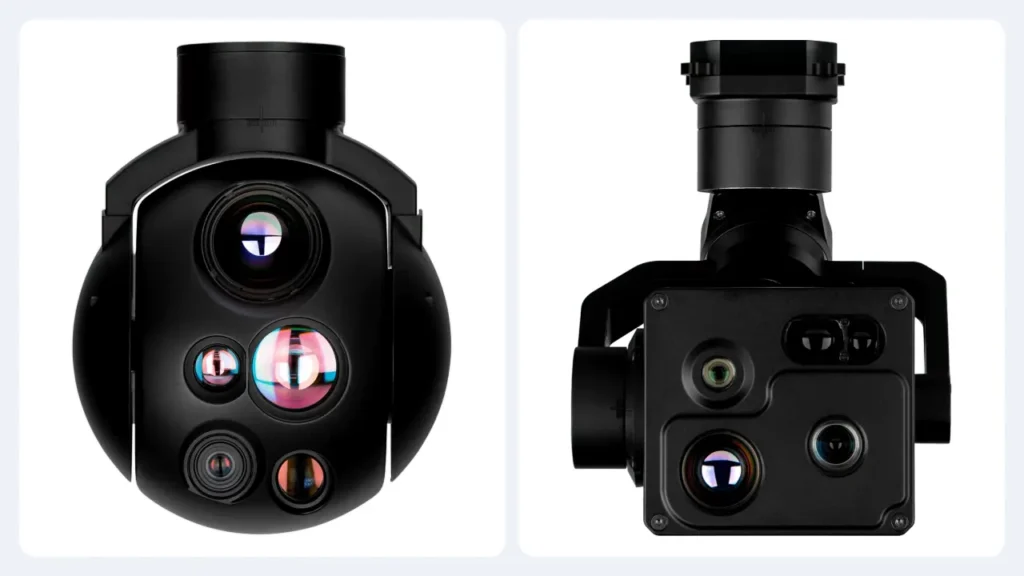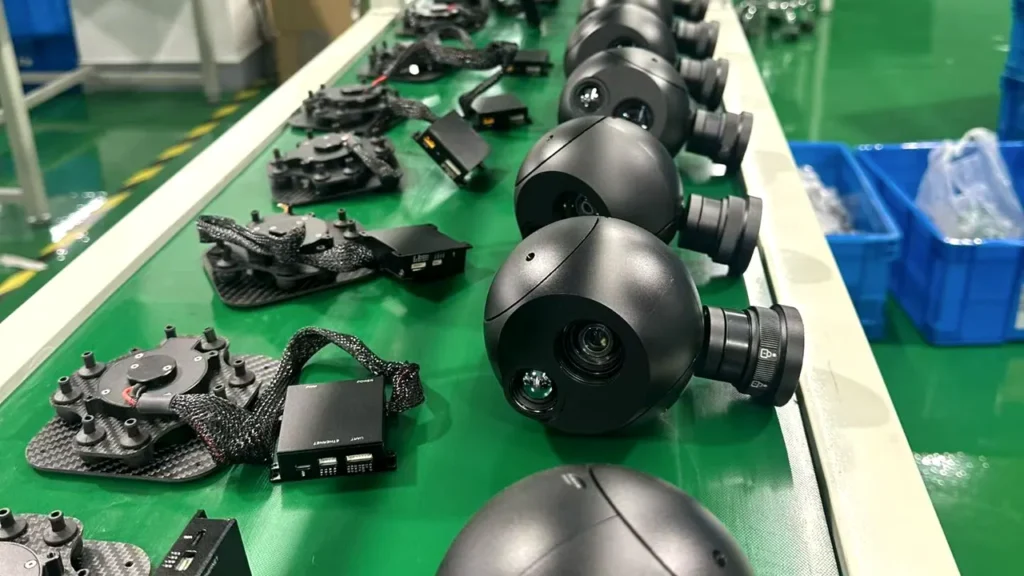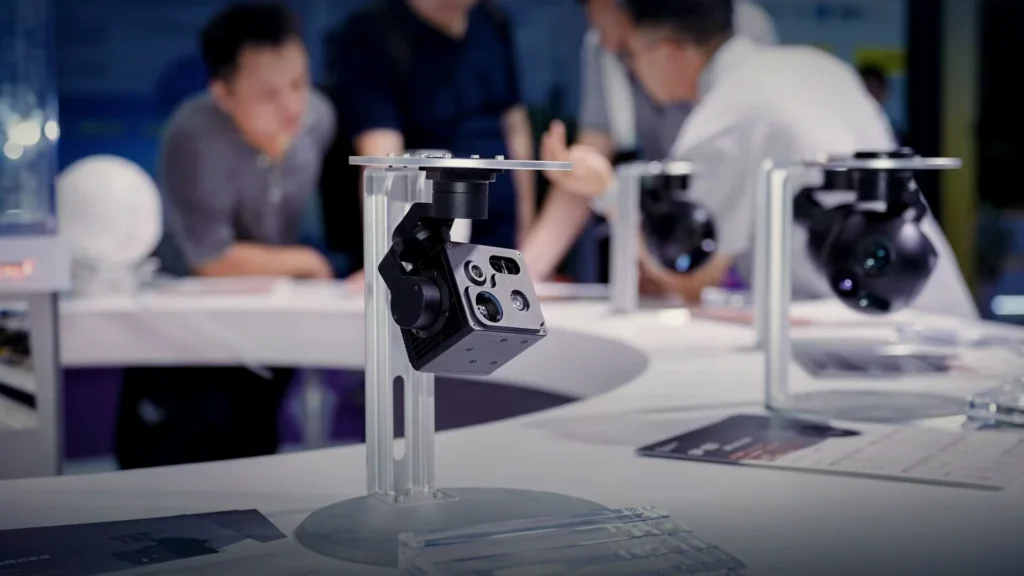
At the 2026 International Low-Altitude Economy Expo in Shanghai, the interesting story wasn’t the airframes. It was the sensor heads. Payload makers spent the week showing that AI inference has moved out of the ground station and into the imaging payload itself. That shift changes what an operator can do with a camera pod, not just how quickly they can do it.
What was on show
It ran from 22 to 25 July at the National Exhibition and Convention Center in Shanghai, after a similar launch round in Shenzhen in May. Two themes dominated the imaging stands.
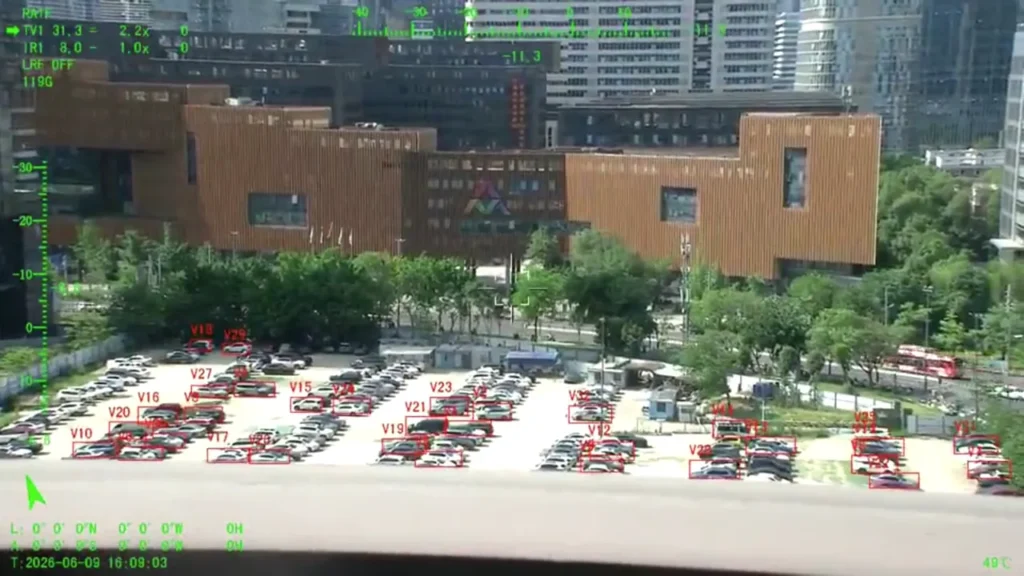
The first was on-board inference. Rather than streaming video to a ground station or a cloud service and waiting for an answer, the payload runs a model locally and outputs detections: what it found, where it is in the frame, and, combined with gimbal angles and a rangefinder, roughly where it is on the ground. Vendors demonstrated object recognition broad enough to classify vehicles, vessels, people and structures without being told in advance what to look for, plus “scene matching” functions where the operator picks a point on a map and the payload finds and locks the corresponding object in the live image.
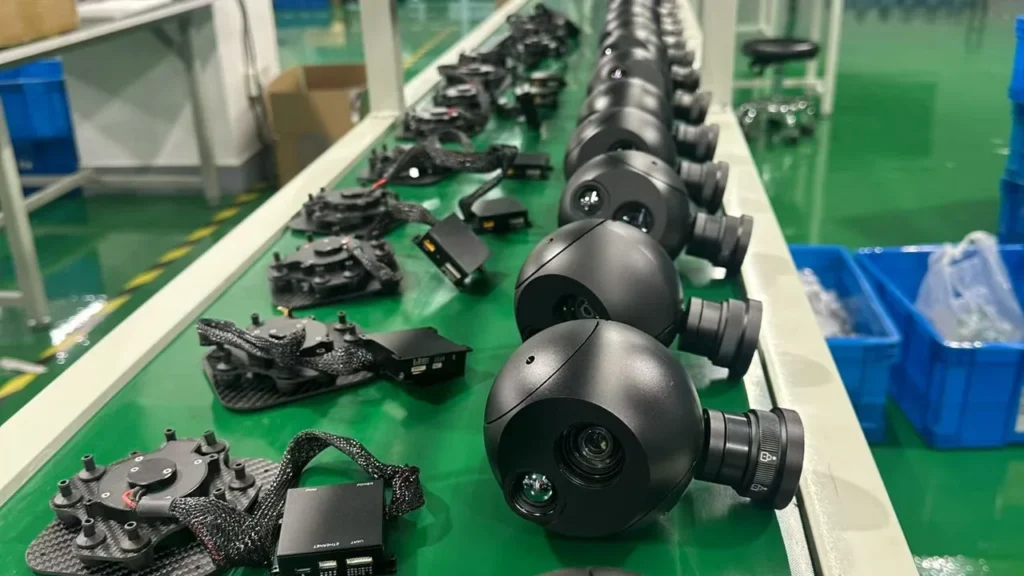
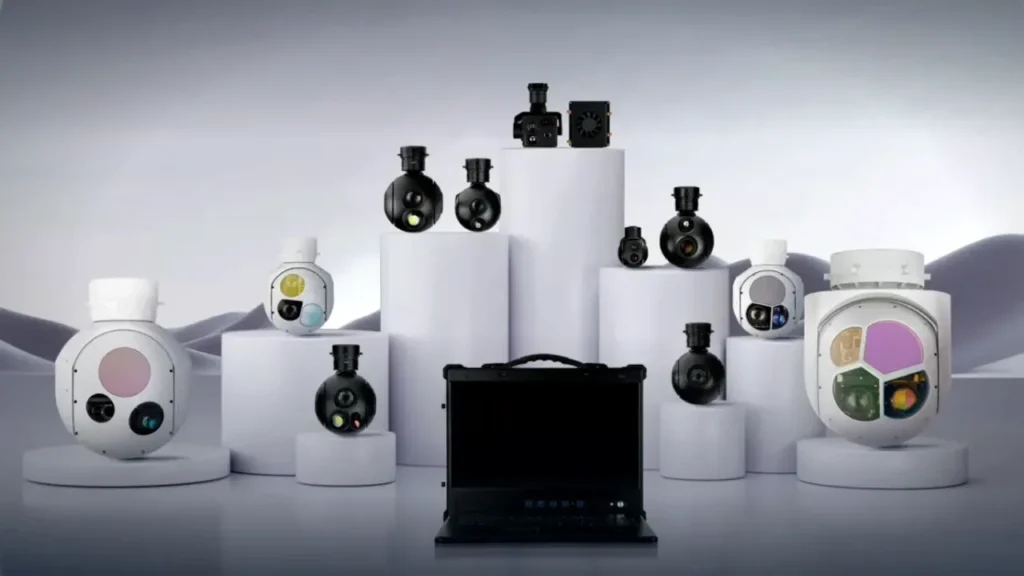
The second theme was retrofit compatibility. The pitch was consistent: the same mass, the same envelope and the same mechanical and electrical interfaces as the analogue generation, with the intelligence added inside. Weight ranges quoted across the industry now start below 300 g and run well past 20 kg. That’s a reminder that “AI payload” isn’t one product, it’s a family spanning small multirotors and large ISR platforms.

From seeing to understanding
For two decades the contract between a payload and its operator was simple: produce the best possible image and let a human interpret it. Three things have changed.
The inference moved
Analysis that used to happen after the flight, sometimes hours after, sometimes on a different continent, now happens during the flight, inside the pod. The practical consequences are latency, bandwidth and connectivity, and they matter most exactly where the work is hardest: over water, in mountains, in RF-contested airspace.
The output changed shape
A payload that understands its imagery doesn’t hand back only a video stream. It hands back a stream plus an object list with tracks, classes and coordinates. That’s a different data product, and it’s what lets a single operator supervise a wide area instead of staring at one narrow field of view.
Operator workload moved
The scarce resource on most missions isn’t sensor resolution, it’s attention. Detection, labelling and tracking that the payload does itself is attention returned to the operator, for the decisions that actually need judgement.
Cloud, ground station, or payload?
These are not competing philosophies so much as three places to put computation, each with a different failure mode.
| Dimension | Cloud pipeline | Ground station | On the payload |
|---|---|---|---|
| Typical latency | Seconds, dominated by the link and queueing | Sub-second to a few seconds | Milliseconds |
| Bandwidth demand | Highest: full-rate video upstream | High: full-rate video to the ground | Lowest: detections and metadata |
| Works with no link | No | No | Yes |
| Model size ceiling | Effectively none | Laptop or rack class | Constrained by mass, power and heat |
| Best at | Fleet-scale analytics, long-horizon fusion, retraining | Multi-sensor fusion, operator-facing tools, reporting | Detection, tracking, cueing, keeping a target locked |
| Failure mode | Link loss ends the capability | Ground equipment becomes the single point of failure | Frozen model until the payload is updated |
The sensible architecture isn’t “edge only” or “cloud only”. It’s inference at the edge, decisions and records on the ground, and training in the cloud. A payload that detects and tracks locally while the ground station fuses, logs and reports is doing each job where the physics allow it.
What has not changed
Exhibition floors reward enthusiasm, so it’s worth restating the parts of the problem that inference doesn’t solve.
- Optics still decide range. No model can identify a vessel that occupies four pixels. Detecting something at 5 km and identifying it at 5 km are separated by focal length, not compute.
- Stabilisation still decides whether the image is usable. A jittering, rolled image degrades a detector as surely as it degrades a human observer.
- Power and heat cap computation. Every watt spent on inference is a watt unavailable for gimbal motors, cooling or endurance. That’s why the same silicon can’t be dropped into a 400 g pod and a 30 kg turret.
- Small models behave differently. A model that runs in a payload is smaller than the one that runs in a data centre. Coverage of rare classes and performance in low contrast will differ from the demonstration video.
- Retrofit is not free. “Same envelope” usually means the mass is unchanged; the thermal budget and the power draw may not be.

Questions worth asking a supplier
If you’re evaluating a payload that advertises on-board intelligence, these eight questions separate a deliverable capability from a demonstration:
- What runs on the payload, and what still requires the ground station or a network connection?
- What is the measured latency from object entering frame to detection leaving the payload?
- How many classes does the shipped model cover, and how is a new class added: on site, remotely, or at the factory?
- What happens to detections when the link drops?
- Does the payload output coordinates, and how are they derived: gimbal angles, rangefinder, or both?
- What is the power draw of the inference load, and the mass of the pod it sits in?
- Can the operator override or reject a track without leaving the video view?
- How are models updated in the field, and does an update require recertification of the platform?
What it means on the aircraft side
On-board inference isn’t only a payload story. It changes what the rest of the system has to carry. A pod that returns detections instead of a full-rate video stream reduces the demand on the datalink, and that budget can go into range, endurance or a second sensor instead. It changes the ground segment too: an operator station that receives an object list can show a map with tracks rather than a single video window, so one operator can supervise more airspace.
The counterweight is power. Inference inside the pod competes with the gimbal for the electrical and thermal budget, and on small airframes that trade is settled in single-digit watts. That’s the practical reason payload families are built around weight classes: the same model can’t be honest across a 300 g head and a 20 kg turret. When a supplier quotes an unusually broad weight range, ask what compute is actually available at each end of it.
There’s a maintenance consequence too. A conventional payload changes behaviour when the firmware changes. A payload with a model on board also changes behaviour when the training data changes. Fleets increasingly need a way to record which model version ran on which mission, for the same reason airframe logs exist.
Key takeaways
- The 2026 Shanghai show confirmed the industry direction: AI inference is moving into the payload rather than sitting behind a link.
- The output of a modern pod is a video stream plus an object list, not just a picture.
- Edge inference wins on latency, bandwidth and operation without connectivity; it loses on model size and update flexibility.
- Retrofit claims should be checked against power and thermal budgets, not mass alone.
- Optics and stabilisation still set the ceiling on what any model can achieve.
Our EO/IR pod systems are built around the same principle: multi-sensor heads with local detection and tracking that behave predictably when the link doesn’t. To see how that is implemented, read the note on AI tracking in UAV payloads, start from the gimbal camera range, or send us your mission profile.