
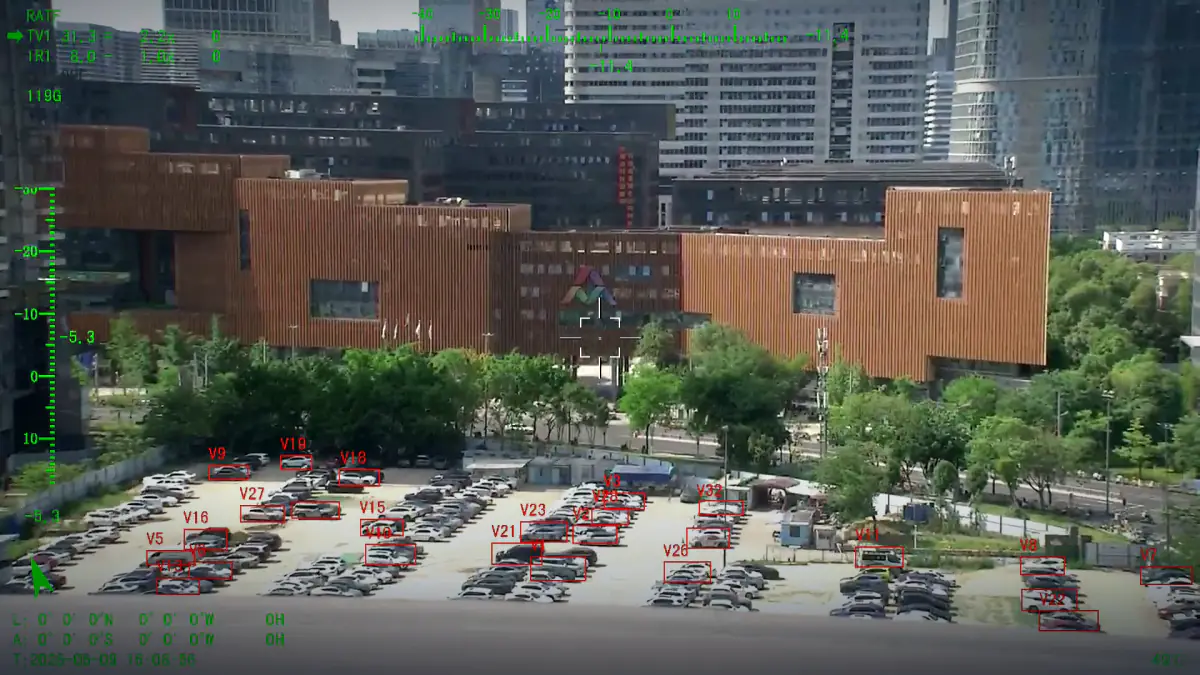
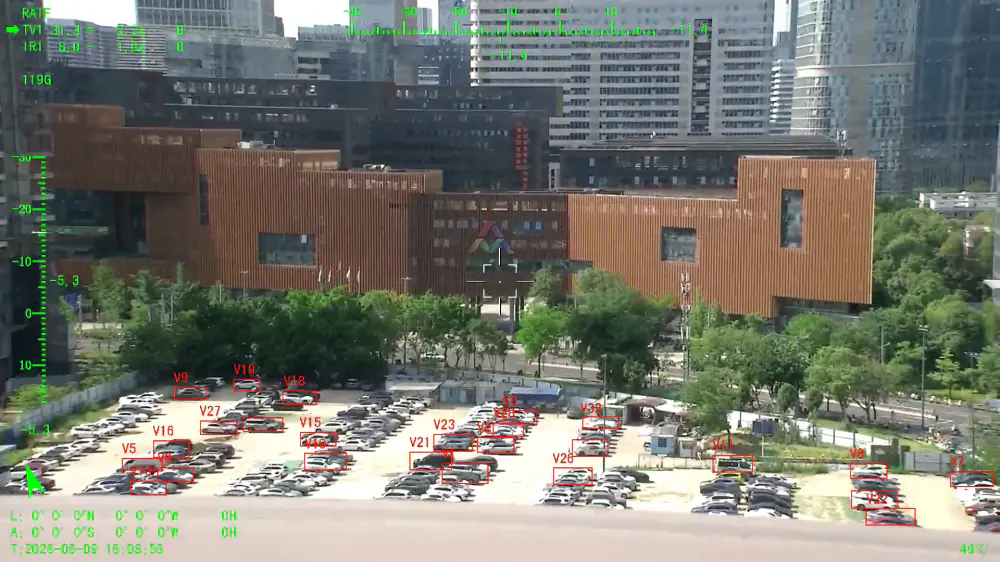
HQ-64DB two-axis gimbal camera
Category: 2-Axis Gimbal Cameras
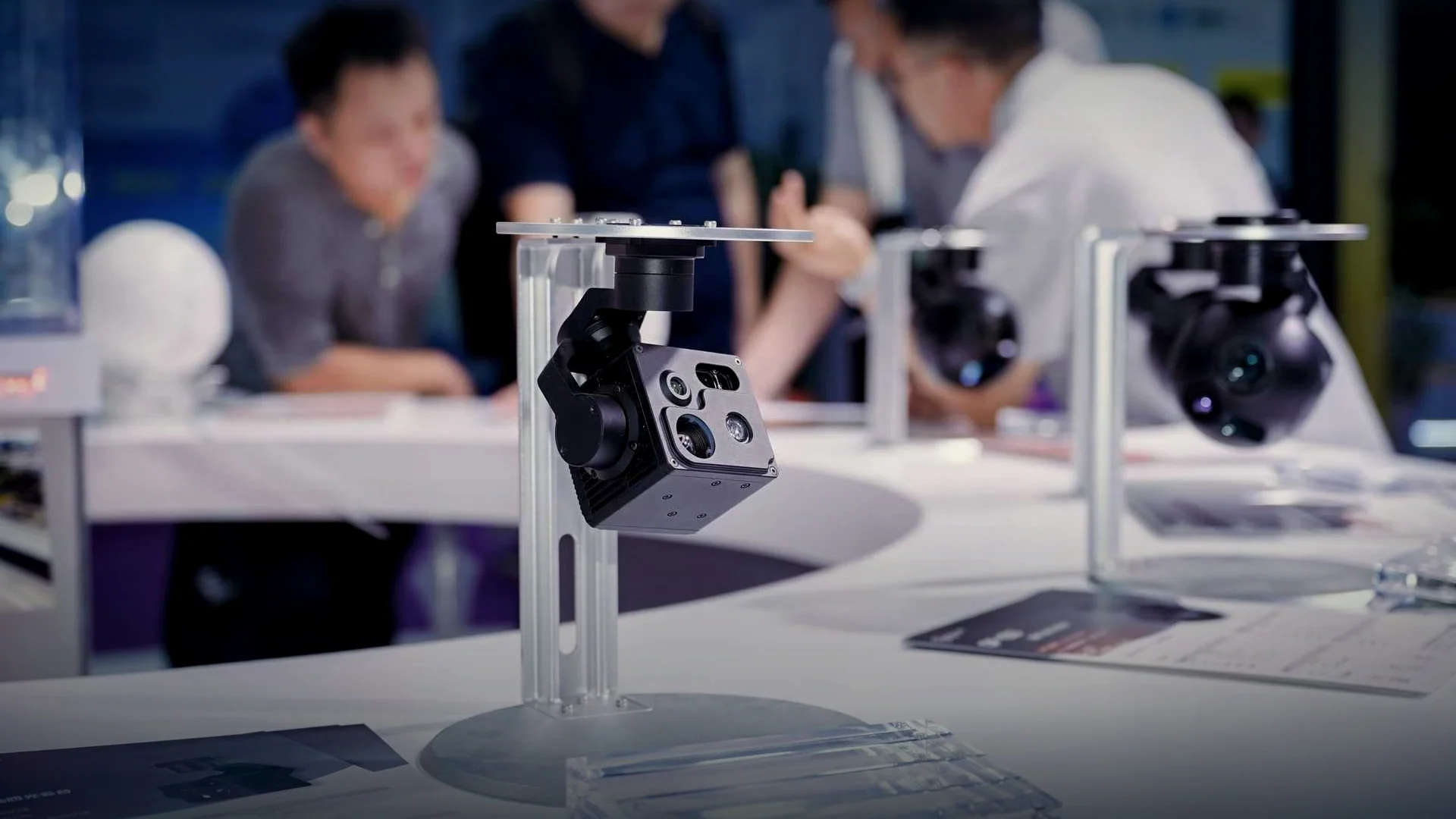
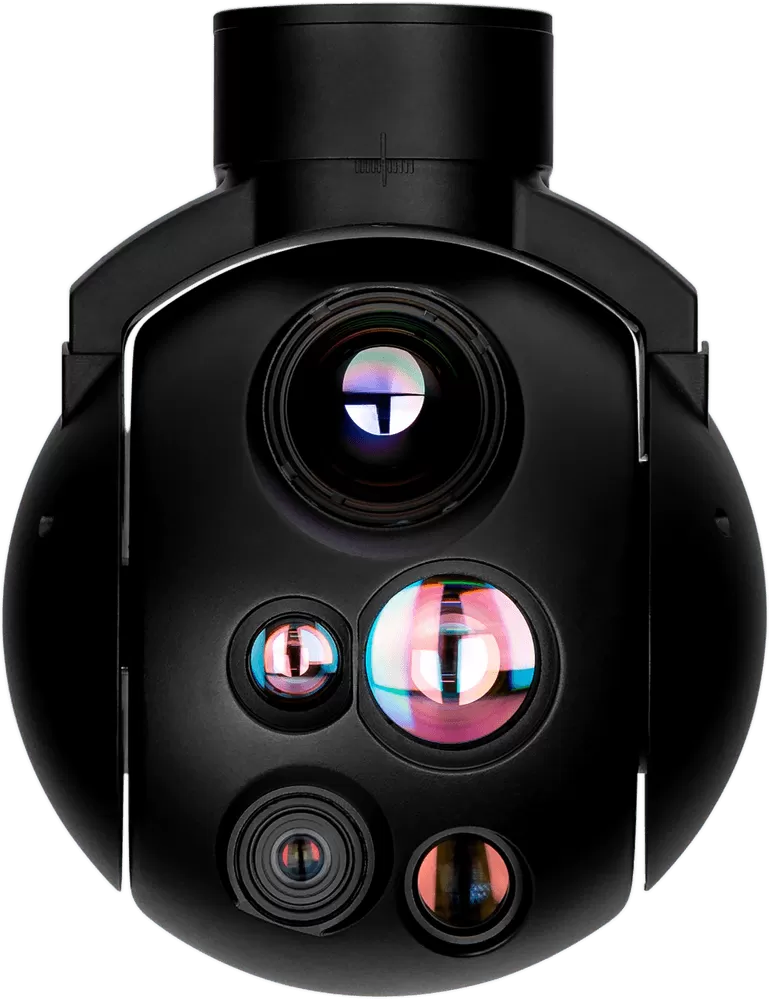
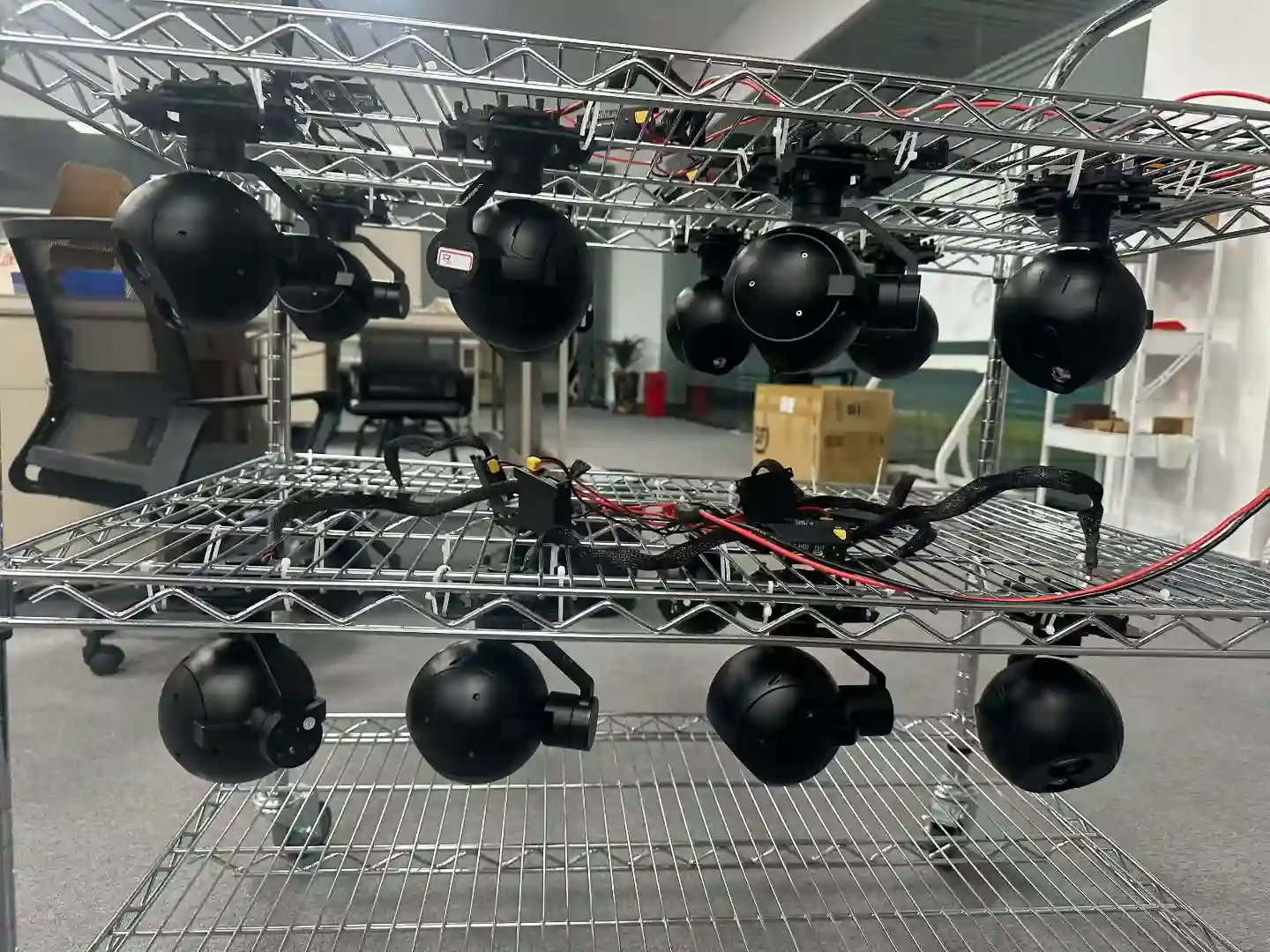
A two-axis gimbal camera that packages EO (electro-optical) into a 240 g head measuring Φ64 × 88.5 mm. Two fixed visible cameras — a wide and a narrow channel — at the lowest weight in the series.
- Weight 240 g
- Two-axis stabilised
- EO Dual 2688 × 1520
- AI detection & tracking
- CE / RoHS documentation available on request
- Export compliance statement available on request
- Calibration and test report supplied with every unit
What the HQ-64DB is
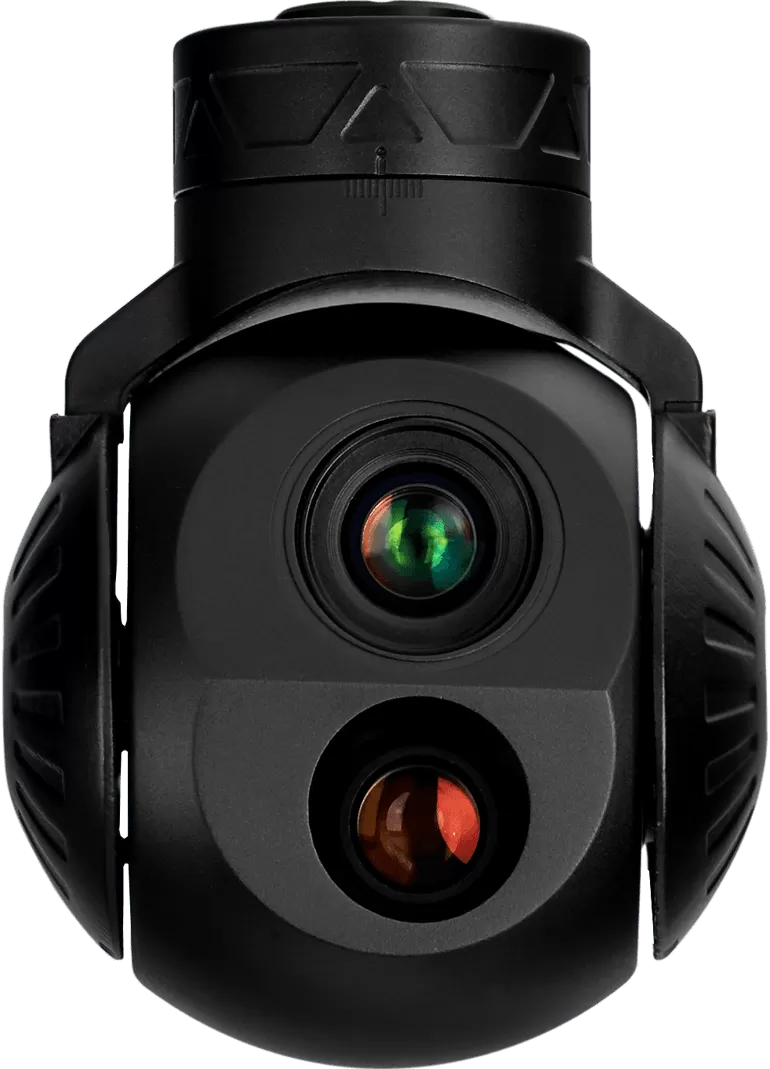
The HQ-64DB is the pair of daylight lenses and nothing else: two 2688 × 1520 arrays, at 8.5 mm for the wide view and 25 mm for the narrow one, on two stabilised axes in 240 g. There is no thermal core, no laser and no third axis. That absence is the product. With no long-wave core to house, the head fits Φ64 × 88.5 mm and weighs 240 g, and it writes a single file per sortie rather than two channels to reconcile afterwards. Detection is 0.73 km on a person and 3.3 km on a vehicle, identical on either lens.
Two daylight focal lengths, one recording
A wide array for the search and a narrower one for the detail, both 2688 × 1520, both feeding one file.
EO / wide
2688 × 1520 at 8.5 mm
The search field. 0.73 km on a person, 3.3 km on a vehicle.
EO / narrow
2688 × 1520 at 25 mm
The same array on a longer lens: same detection figures, a narrower slice of the scene.
Why two focal lengths instead of one
A single wide lens finds things; a single long lens reads them but searches badly. Two fixed groups at 8.5 mm and 25 mm cover both ends without a zoom mechanism, and because the change is a switch rather than a motorised travel there is nothing in the head to drift between the two positions. The operator keeps the wide frame for the sweep and flips to the narrow one once something in the picture needs a closer look. Both arrays are 2688 × 1520, so the narrow channel resolves the same detail as the wide one instead of trading resolution for focal length.
What dropping the thermal core buys
240 g, the lightest head in the series. The published draw is 10 W / 20 W, the same as the two-sensor head beside it, so this is not a power saving: the gain is mass, and on a hand-launched aircraft every gram comes out of endurance. The second gain does not show on the scale at all. One imaging path means one stream to record, one file to hand over and no boresight to preserve between two channels. On a daylight task that is a simpler aircraft, not merely a lighter one.
A thermal core is worth its mass when the task runs after dark or through smoke. When it does not, that mass and the extra stream are cost with no return, and a head built without them stays lighter for the whole sortie.
Stabilisation and mechanical design
Two axes, no roll correction
Pitch and yaw are stabilised; roll is the aircraft’s job. Each axis runs on a brushless motor fixed straight to the frame, encoding in the loop, so no reduction gear introduces lash or step noise. Boresight holds to ≤ 100 μrad (1σ) at ≥ 60°/s.
240 g, Φ64 × 88.5 mm
Mass is 240 g and the envelope Φ64 × 88.5 mm, the smallest in the series and the reason this head suits hand-launched and backpack-carried aircraft. It runs on 11–28 VDC and draws 10 W / 20 W.
Detection and tracking at the edge
Detection without a downlink
People, vehicles, vessels and aircraft are identified by a module on the payload, not the ground. Boxes keep appearing when bandwidth falls away, and no image is transmitted for a processor. Twenty targets at once, one actively locked.
Occlusion, and the file afterwards
The tracker follows a selected target through rotation and scale change, and picks it up again once a mast or a building stops hiding it. Everything is written to storage inside the head, so a pass recorded through a bad link is still on the card when the aircraft lands.
Airframe integration
A light head still needs a defined mount, a defined bus and a defined set of documents.
Mount and mass
Quick-release face, vibration-isolated base, adapter plates for a different bolt circle. At 240 g and Φ64 × 88.5 mm the head drops onto a small multirotor or a hand-launched airframe without a bespoke bracket, and both numbers are catalogue limits, so the structural case is closed before a prototype exists.
Bus and housing
Between 11 and 28 VDC in, RS-422, RS-232 or TTL for commands, SBUS or MAVLink where the autopilot uses them, H.264 or H.265 over 100 Mbps Ethernet for imagery, and 128 GB of internal storage. Sealed against dust and rotor wash, rated −20 °C to +60 °C running and −40 °C to +70 °C stored. The layer is shared across the range and described on the technology pages.
Beside the rest of the range
Two axes, one control protocol. A crew that already flies a three-axis turret can add this head to the same ground station without a second integration.
Documentation for the first head: control protocol, video pipeline description, three-view outline with pinout, calibration record and test report. Export screening applies to the paperwork exactly as it applies to the head.
Where the HQ-64DB is used
Three jobs where a daylight pair beats a daylight-plus-thermal head.
- Daylight corridor survey
A pipeline, a road or a rail corridor is flown in light by definition, and the work is a wide sweep followed by a closer look at what the sweep turns up. The 8.5 mm channel does the sweep, the 25 mm channel does the look, and no part of the flight depends on a thermal core that is drawing power without being used. Flying it on a 240 g head keeps the aircraft small enough to launch from the corridor edge.
- Construction progress records
Progress capture is a repeatable comparison: the same frame, from the same angle, on a schedule. Two fixed focal lengths remove the variable a zoom would introduce, so successive flights line up and a change is something the client can see rather than something the surveyor has to describe. One channel also means one file per visit, which is what an archive wants.
- Backpack-launched overwatch
Where the aircraft is carried in and launched by hand, every gram shows up as minutes aloft. At 240 g this head leaves the battery budget for the flight rather than for the payload, and the wide and narrow pair still gives a crew a search field and a detail field from one aircraft.
Full specifications
| Model | HQ-64DB |
| Series | Gimbal Camera Series (HQ series) |
| Stabilisation | Two-axis gyro-stabilised, ≤ 100 μrad |
| Sensor configuration | EO |
| Visible channel | Dual 2688 × 1520, 8.5 mm + 25 mm |
| Weight | ≤240 g |
| Dimensions | ≤Φ64 × 88.5 mm |
| Power consumption | 10 W / 20 W |
| Detection (EO) | 0.73 km person / 3.3 km vehicle |
Detection distances follow the standard 1.7 m person / 2.3 m vehicle convention. Rows marked as shared are common across the HQ series.
Control software: Windows as standard. An Android version can be customised for OEM/ODM projects.
Shared across the HQ series
- Video output: Ethernet, H.264 / H.265
- Gimbal control: RS-422 / RS-232 / TTL, SBUS, MAVLink
- Input voltage: 11–28 VDC
- Operating temperature: −20 °C to +60 °C
- Sealing: Sealed housing for dust, wind and rotor wash
- Recording: On-board recording, imagery retained if the link drops
- AI module: Onboard detection, classification and multi-target tracking
- Mounting: Quick-release interface, adapters available for OEM (original equipment manufacturer) airframes
Three-view outline drawing with connector pinout, available on request.
Other 2-axis gimbal cameras
Two compact two-axis heads for airframes with limited payload space. The control protocol and the video path are the same as the rest of the range.
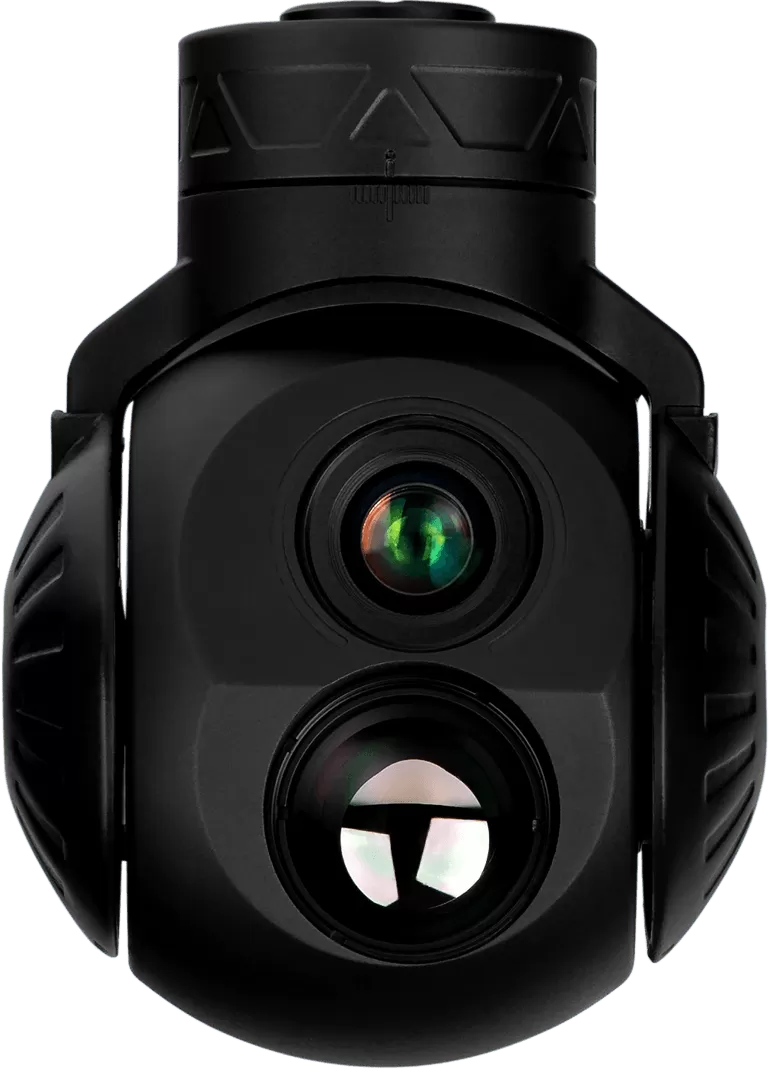
HQ series · 2-axis · EO + IR
HQ-64DA UAV Camera Gimbal OEM
The lightest dual-sensor head in the range — 2K daylight plus thermal on 260 g.
- Weight
- ≤260 g
- Visible
- 2688 × 1520, 8.5 mm fixed
- Thermal
- 640 × 512, 19 mm fixed
HQ series · 2-axis · EO + IR + LRF
HQ-85Q Stabilised Camera Payload ODM
Adds 3 km laser ranging to a two-axis platform for crews that need coordinates, not just imagery.
- Weight
- ≤500 g
- Visible
- Dual 1920 × 1080, 8 mm + 25 mm
- Laser
- 15 m – 3 km (± 1 m)
Questions engineers ask about the HQ-64DB
How far does the HQ-64DB pick up a person or a vehicle?
0.73 km and 3.3 km, on either the 8.5 mm or the 25 mm lens, against the standard 1.7 m person and 2.3 m vehicle targets. Detection is the same on both channels because both arrays are 2688 × 1520; what changes is how much of the scene sits in the frame.
What are the order terms and the delivery time?
Buy one unit and it arrives as a catalogue item; change the optics, mount or protocol and the run begins at 100. Catalogue stock leaves the shelf immediately, leaving only transport in the way, while a bespoke or volume batch has its date written into the quotation. Settlement is T/T; cover runs twelve months.
Is a thermal core ever the better choice?
Only when the task runs after dark or through smoke, dust or haze thick enough to defeat the visible channel. A thermal core at 640 × 512 costs mass, continuous power and a second stream to record; where none of the three is needed, the daylight pair does the work on 240 g.
Why is there no third axis?
Because roll is already held by the aircraft on the platforms this head is built for. Pitch and yaw are stabilised to ≤ 100 μrad (1σ) at ≥ 60°/s, and adding a roll axis would add mass and volume to a head whose whole argument is that it weighs 240 g.
Designed and manufactured by HITS
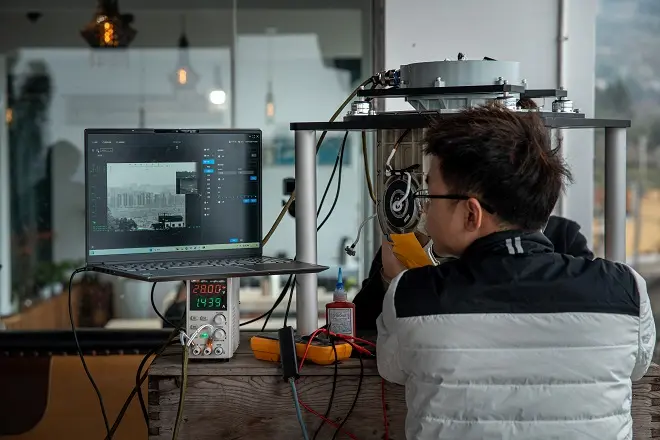
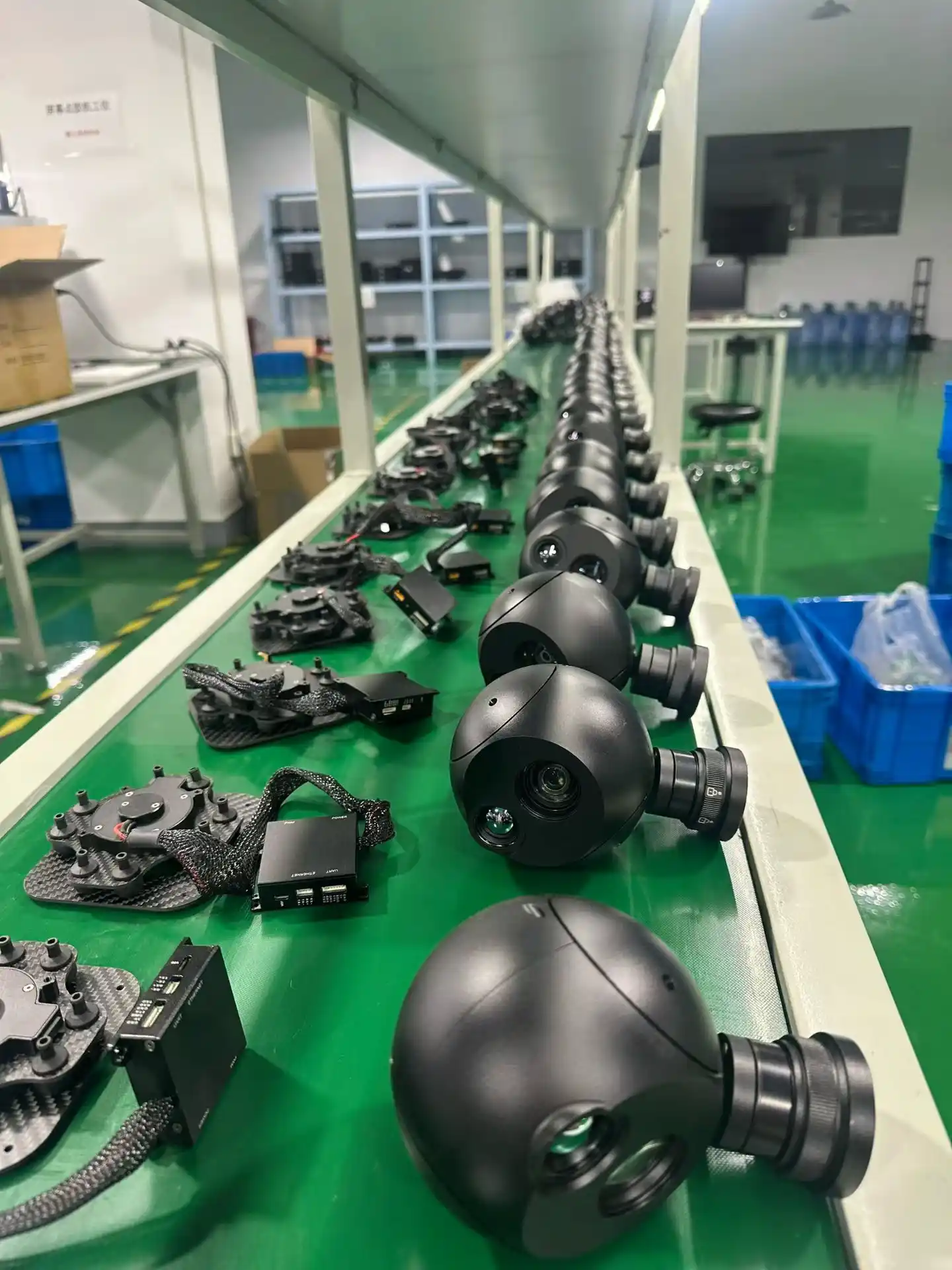
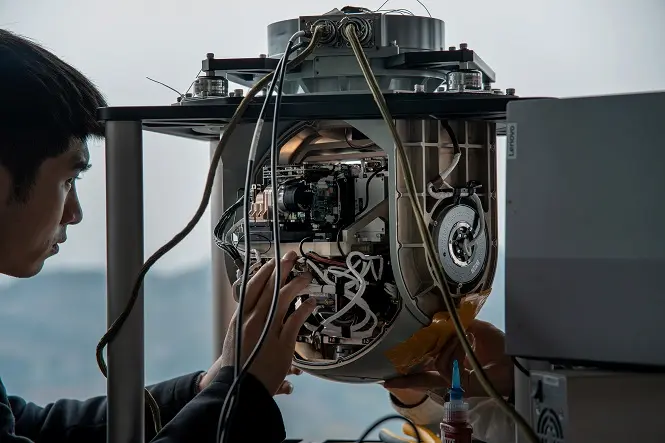
Optics, servo hardware, stabilisation firmware and the AI tracking module are developed in house, and every unit is assembled, calibrated and environmentally tested on our own line before it ships.
Request a quotation for the HQ-64DB
Tell us the platform, the range you need to identify and how many units you are planning. Every configuration is quoted individually, so you get a written price against your own requirement rather than a list figure that does not fit it. We answer within one working day.
Explore all product categories
Nine routes into the range: by stabilisation, by sensor set, or by payload class. Each category page compares the models and links to the full specification.
15 models · 240 g – 5 kg
Gimbal Cameras
Two- and three-axis stabilised heads with EO, thermal and laser options.
View category →
3 models · 240 – 500 g
2-Axis Gimbal Cameras
The lightest HQ heads: fixed or dual-FOV optics on a compact two-axis mount.
View category →
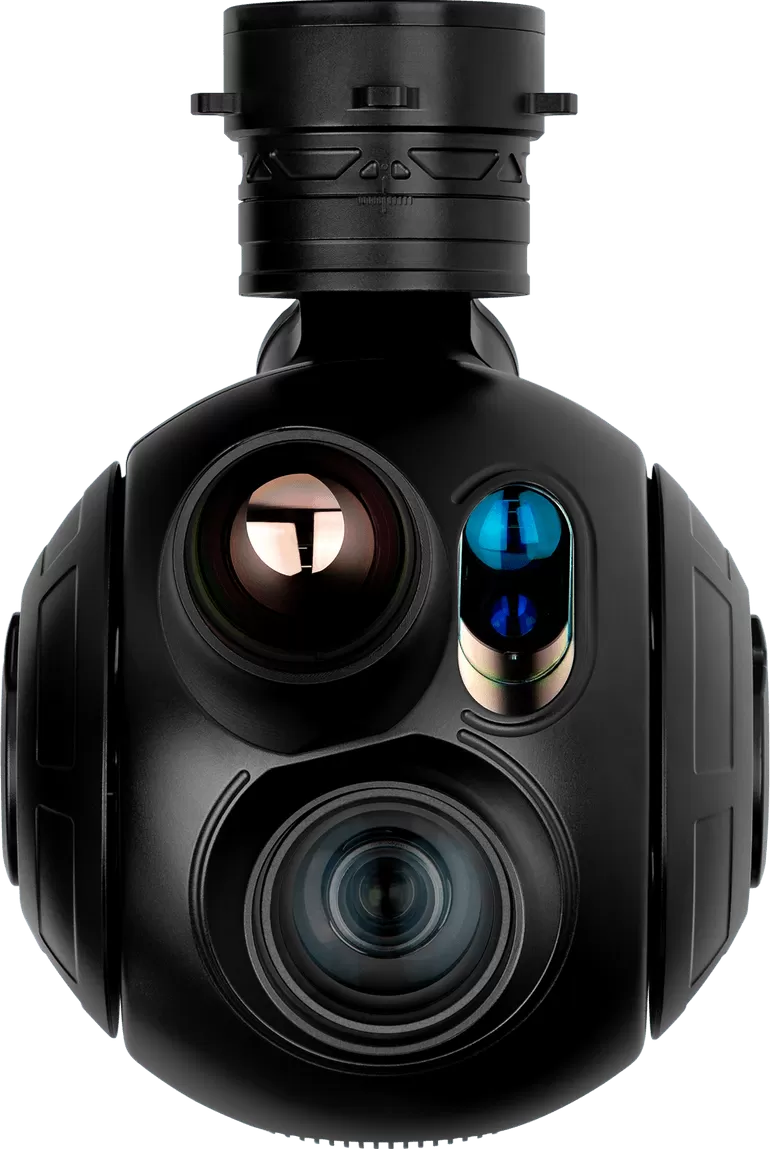
12 models · 400 g – 5 kg
3-Axis Gimbal Cameras
Roll-stabilised heads with longer zoom ranges and heavier payload capacity.
View category →
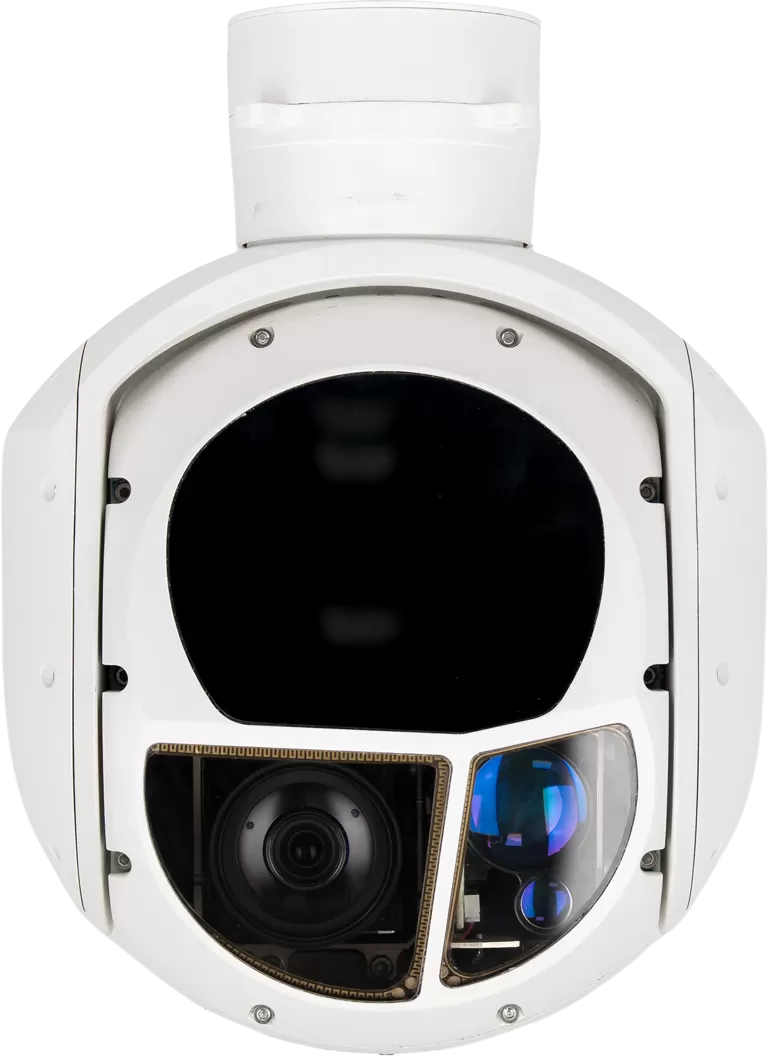
8 models · 1.6 – 10 kg
EO/IR Pod Systems
Larger multi-sensor pods with 30x–55x zoom, thermal imaging and laser ranging to 15 km.
View category →
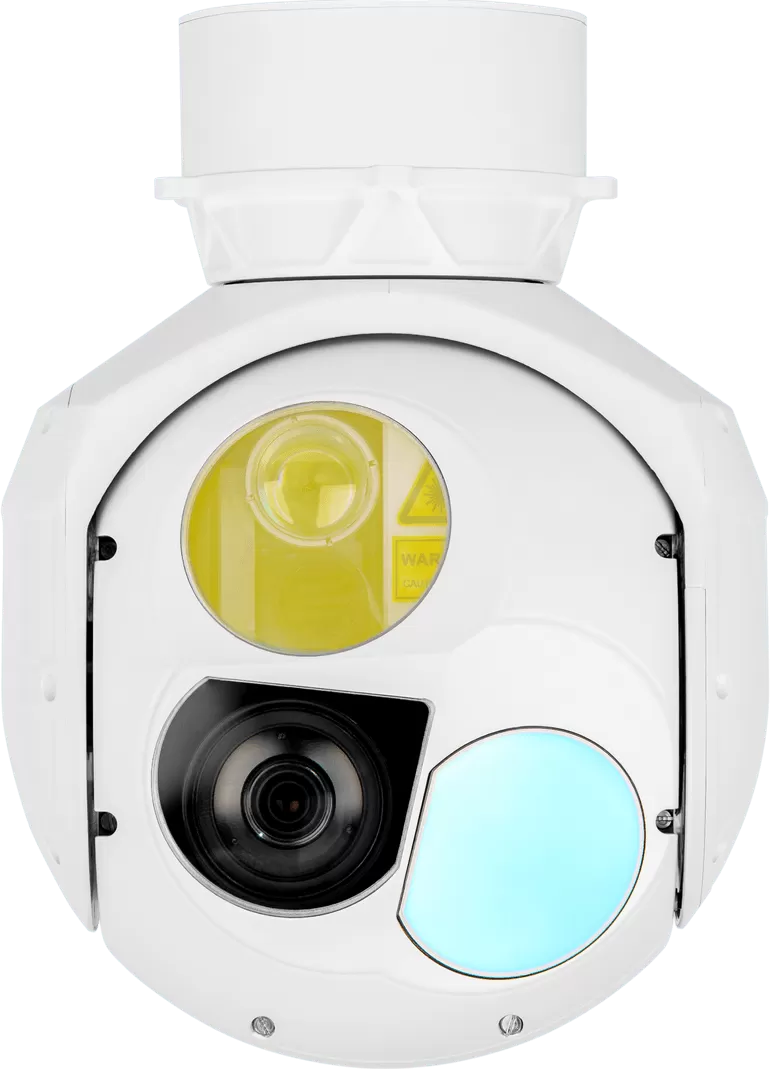
4 models · 2.5 – 22 kg
Laser Designator Pods
Targeting pods that add 1064 nm designation to the same imaging and stabilisation architecture.
View category →
Sensor guide
Thermal Cameras
Detector, lens and range: how uncooled LWIR payloads are specified for UAVs.
View category →
Sensor guide
Infrared Cameras
How to match an IR detector, lens and interface before choosing a gimbal.
View category →
Sensor guide
EO Cameras
Visible-channel sensors, zoom lenses and the resolution needed at range.
View category →
Sensor guide
EO/IR Cameras
Boresight, sensor pairing and the trade-offs of a dual-sensor head.
View category →