Maritime work is where an imaging payload earns its keep or fails: long distances, moving targets, glare off open water, assets scattered across tens of kilometres, and work windows that don’t stop when the light goes. This guide covers what airborne inspection actually looks like over water, and how to match a gimbal camera to the mission instead of the other way round.
Why the water changes the problem
Over land, a payload can lean on a busy background, short ranges and daylight. Over water almost every one of those assumptions breaks.
- Targets are small and far away. A 12 m workboat at 3 km subtends very few pixels unless the lens is genuinely long. Detail comes from focal length first, resolution second.
- The scene never stops moving. Swell, wind and aircraft motion are all in play. Without accurate multi-axis stabilisation, a zoomed image is unusable long before it is unreadable.
- Water is an optically hostile background. Sun glitter, specular reflection, haze and a low-contrast horizon defeat contrast-based autofocus and punish poor exposure handling.
- Assets are dispersed. A lighthouse, three buoys and a wind farm can be 20 km apart. Sending a boat to each one is measured in days; a single sortie is measured in minutes.
- Night work is normal. Patrol, search and response tasks don’t pause at sunset, so a thermal channel is a requirement rather than a feature.
What a maritime payload has to do
Four jobs come up on almost every over-water task, and they pull the specification in different directions.
Keep a picture of a busy area
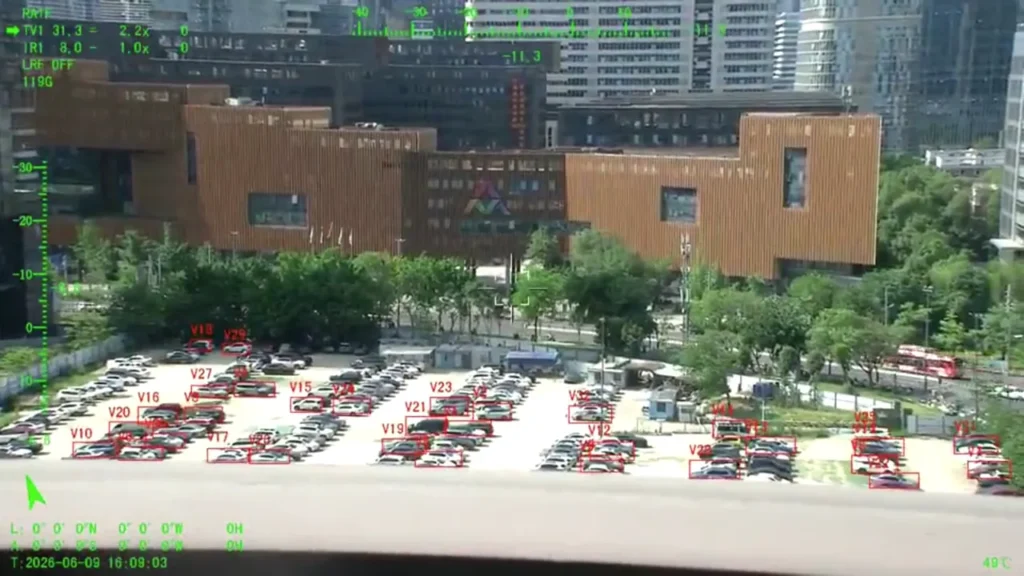
Anchorage and harbour work is rarely about one vessel. The useful output is a running picture: targets observed continuously, numbered, and refreshed as the aircraft moves, so an operator on shore can refer to “target 7” without ambiguity. Detecting and numbering a dispersed set of small targets is a detection problem; identifying any single one of them is a lens and stabilisation problem. A payload that’s good at the first and weak at the second will frustrate the operator within an hour.
Identify a specific vessel without closing on it
Once a target is selected, the job is to read hull detail, superstructure and, where possible, the name or registration. That happens on the visible channel with optical zoom, from a standoff distance that respects safety and legal constraints. Long focal length plus enough stabilisation accuracy to hold a target steady at full zoom is the single most demanding requirement in maritime imaging.
Rule of thumb: if the payload can’t hold a target steady at maximum zoom in a 10 kt wind, the maximum zoom figure in the datasheet is marketing, not capability.
Work through a list of fixed assets
Lighthouses, buoys, aquaculture pens and offshore wind turbines are inspected against a checklist rather than hunted. The payload needs to be pointed at a known coordinate, zoomed, held long enough for a clean look, then marked as done. Practical checks include:
- Lighthouse or beacon: structure condition and whether the light is operating.
- Buoy: position relative to chart, structure, and light or reflector state.
- Wind turbine: blade leading edges, tower and transition piece, plus a record of any visible damage or marine growth.
Keep working after dark
A cooled or uncooled infrared channel turns a night patrol into a daylight-equivalent task: vessels, machinery and people all present a thermal signature that survives darkness, haze and light rain. Pair that with a laser rangefinder and the operator can record a target position rather than just a picture of it.
Two axes or three?
This is the first decision in most maritime projects, and it’s usually settled by weight and by how dynamic the platform is.
| Question | 2-axis gimbal | 3-axis gimbal |
|---|---|---|
| Stabilised axes | Yaw and pitch | Yaw, pitch and roll |
| Best fit | Calm air, single-target observation, weight-limited aircraft | Dynamic airframes, high zoom, video that will be reviewed later |
| Typical mass | From a few hundred grams upward | From roughly 800 g upward |
| Maritime role | Fixed-wing patrol, buoy and beacon checks, small-target search | Vessel identification at range, offshore assets, night patrol |
| Watch out for | Roll error appearing as horizon drift at long focal lengths | Mass and power budget on smaller airframes |
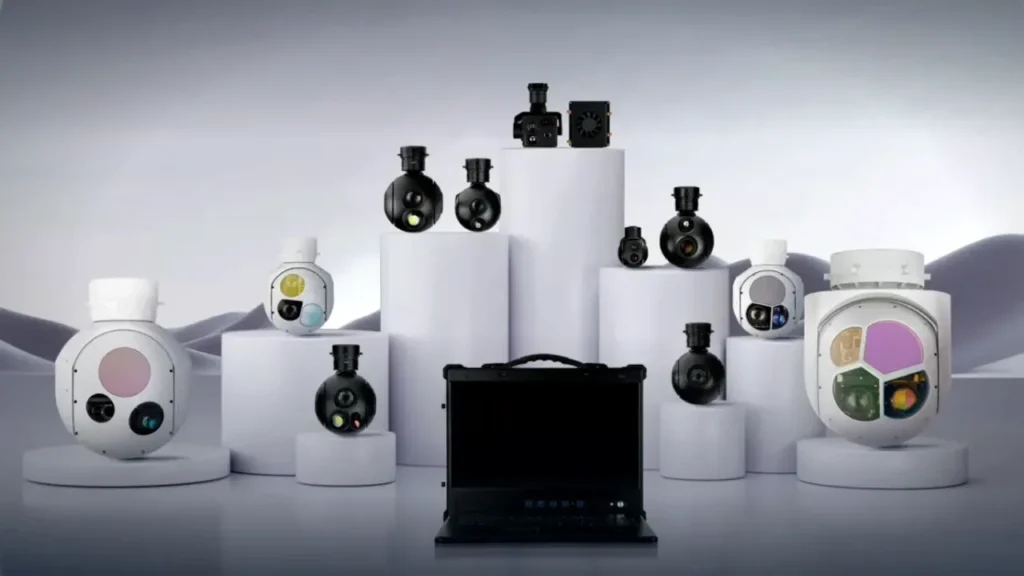
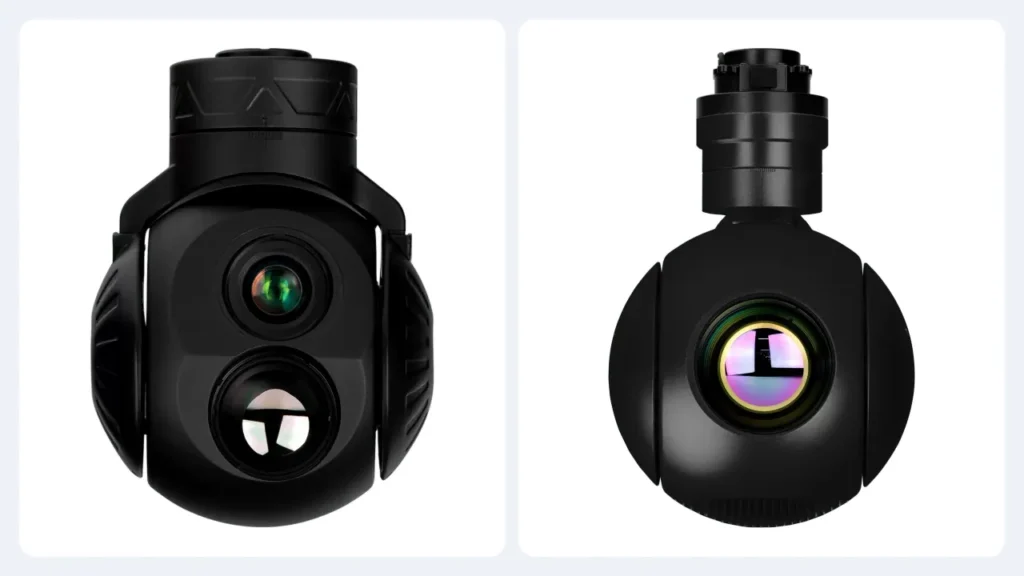
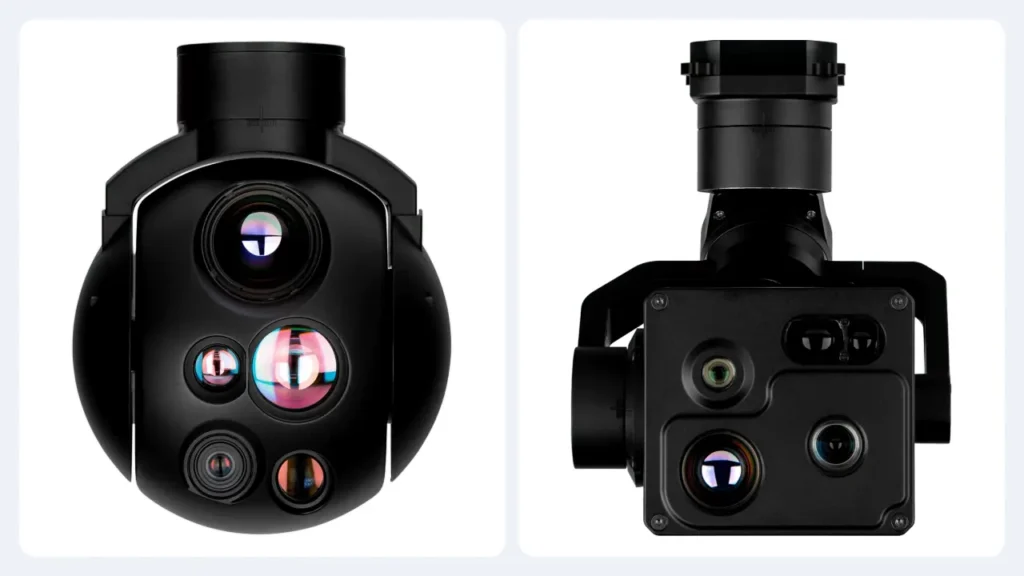
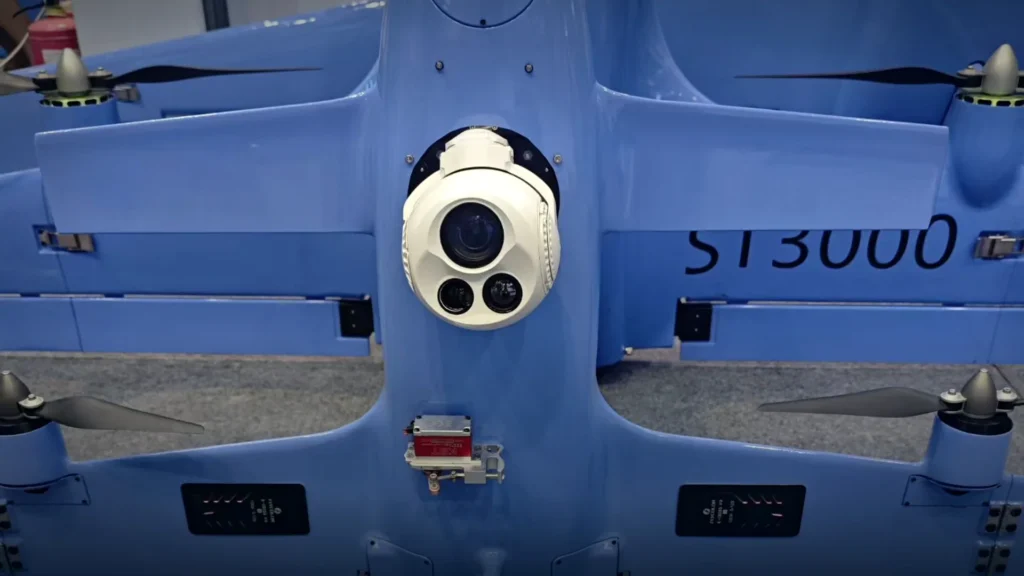
A compact two-axis head is often the right answer for a fixed-wing patrol aircraft that cruises smoothly and mostly needs to find and count things. The 2-axis gimbal camera family covers that pattern, including heads with visible, infrared and rangefinder channels in one pod. A three-axis head earns its mass the moment the mission involves holding a zoomed image steady on a moving vessel from a multirotor in gusty air.
Matching payload to mission
| Mission | Channels needed | Range class | Starting point |
|---|---|---|---|
| Anchorage and harbour overview | Visible, wide to medium zoom | 1–3 km | 2-axis EO head |
| Vessel of interest identification | Visible, high optical zoom | 3 km and beyond | 3-axis EO or EO/IR head |
| Buoy, beacon and lighthouse status | Visible, medium zoom, night channel for light state | 1–3 km | 2-axis EO/IR head |
| Offshore wind inspection | Visible high zoom plus IR for moisture and hot spots | 1.5–5 km | 3-axis EO/IR head, for example the HQ-125TB |
| Night patrol and search | IR primary, visible secondary | Depends on IR lens | EO/IR head with low-light tuning |
| Small target search and rescue | Visible wide, IR for people and craft | Wide area first | See airborne inspection solutions |
Integration notes: what to send with the aircraft
Most maritime projects are lost or won in integration rather than imaging. Before ordering, have answers to these:
- Mass and centre of gravity. A 900 g head on a 6 kg multirotor changes endurance more than any software setting.
- Mechanical interface and power. Damping, mounting pattern, supply voltage and peak current.
- Video and metadata. Whether the payload overlays coordinates, azimuth, elevation and range onto the recording, and how those values reach the ground station.
- Autonomy behaviour. Whether on-board detection keeps the operator’s workload down, as covered in our AI tracking note, and how the operator overrides it.
- Record and replay. Inspections are evidence: file format, timestamps and whether footage is stored on the payload or the aircraft.
What to look for on a datasheet
Six numbers decide whether a payload will work over water: optical zoom ratio and top focal length; sensor format and pixel pitch; stabilisation accuracy under motion; infrared resolution and lens focal length; rangefinder class and maximum range; and mass, including the interface. Everything else, from branding to app support, is secondary to those six.
Key takeaways
- Over water, focal length and stabilisation decide the result; resolution only decides how nice it looks.
- Detection of many targets and identification of one target are different problems with different payloads.
- Dispersed fixed assets such as lighthouses, buoys and turbines reward a single sortie far more than closer approaches.
- A thermal channel converts night work from a compromise into a normal task, and a rangefinder converts pictures into positions.
- Two axes are usually enough for smooth, weight-limited platforms; three axes pay for themselves at long focal lengths.
If you’re specifying a payload for maritime or offshore work, send us the aircraft, the mass budget and the smallest detail you need to read at range. We’ll come back with a matched configuration and a quotation. Start with the 2-axis gimbal camera range, or talk to our engineering team.