





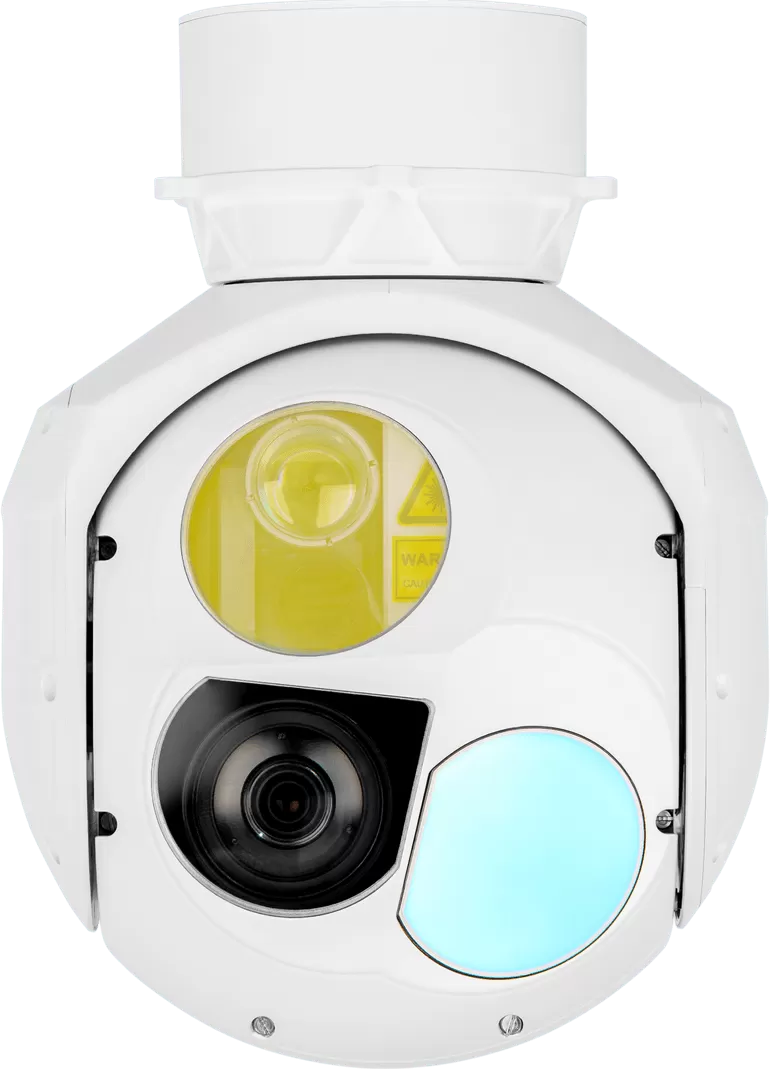
SQ-155T two-axis laser designator pod
A two-axis laser designator pod for long-endurance fixed-wing aircraft, helicopters and heavy multirotors. A 2.5 kg targeting pod with 1064 nm designation and ranging from 120 m to 5 km.
- Weight 2.5 kg
- Two-axis stabilised
- EO 1920 × 1080
- Thermal 640 × 512
- LRF 120 m – 5 km (± 1 m)
- AI detection & tracking
- CE / RoHS documentation available on request
- Export compliance statement available on request
- Calibration and test report supplied with every unit
What the SQ-155T is
Configured as EO plus IR plus LRF plus laser designator, the SQ-155T sits at 2.5 kg with a Φ155 × 213 mm envelope, which places it with long-endurance fixed-wing aircraft, helicopters and heavy multirotors. A 2.5 kg targeting pod with 1064 nm designation and ranging from 120 m to 5 km.
Core capabilities
The features that decide whether imagery is usable in the air, in the order an integrator usually checks them.
- Gyro-stabilised line of sight
Direct-drive brushless axes with high-resolution encoding hold the line of sight to ≤ 100 μrad (1σ), and the stabilisation loop reacts at ≥ 60°/s angular velocity so imagery stays steady in turbulence and rotor wash.
- Continuous optical zoom
The visible channel is 1920 × 1080, 30x zoom 4.3 – 129 mm. Continuous zoom keeps a wide search field and a tight identification field available without changing lenses, with autofocus and electronic image stabilisation at sub-pixel level.
- Uncooled thermal channel
640 × 512, 35 mm fixed, long-wave infrared with NETD ≤ 40 mK, boresighted to the visible channel so both sensors point at the same target with no re-alignment in flight.
- Laser rangefinding
The rangefinder measures 120 m – 5 km (± 1 m) at an eye-safe 1535 nm, which turns video into a distance measurement and feeds the target coordinate calculation.
- Onboard AI detection
Person, vehicle, vessel and aircraft detection runs on the payload itself, with no dependency on the data link and no frames sent to a ground station for processing.
- Multi-target tracking
Lock and follow up to 20 targets at once, with anti-occlusion logic that re-acquires a target after it passes behind terrain, a mast or another object.
Stabilisation and mechanical design
Two axes, direct drive
Pitch and yaw are driven directly by brushless motors with high-resolution encoding, which keeps the line of sight steady without gear backlash. The loop is specified at ≥ 60°/s angular velocity and holds the line of sight to ≤ 100 μrad (1σ).
2.5 kg in Φ155 × 213 mm
The complete head weighs 2.5 kg and measures Φ155 × 213 mm, with 11–28 VDC input and power consumption of 30 W / 150 W. That envelope lets long-endurance fixed-wing aircraft, helicopters and heavy multirotors carry the payload without a bespoke mount.
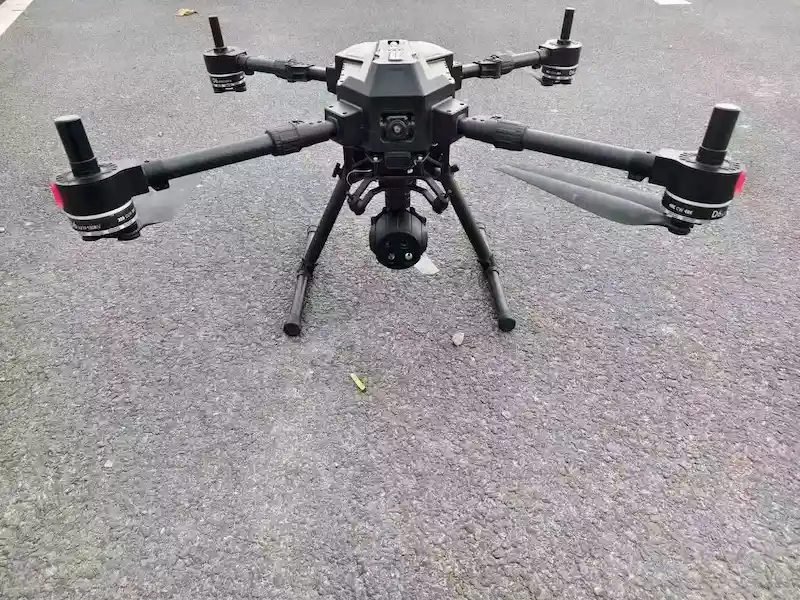
On the aircraft
Mounting, cable routing and vibration isolation are agreed with the platform integrator, so the payload drops into an existing airframe interface instead of needing a bespoke mount.
Multi-sensor payload
Configured as EO plus IR plus LRF plus laser designator. Each channel is boresighted to the others, so one target sits in the same place on every screen.
EO / visible
1920 × 1080, 30x zoom 4.3 – 129 mm
Detection 6 km person / 15 km vehicle.
Thermal / IR
640 × 512, 35 mm fixed
Detection 1 km person / 4.6 km vehicle.
Laser rangefinder
120 m – 5 km (± 1 m)
Eye-safe 1535 nm, feeding target coordinates.
Channel detail
A sensor specification on its own rarely answers the operational question, so each channel is described here with the distance it actually supports.
EO / visible
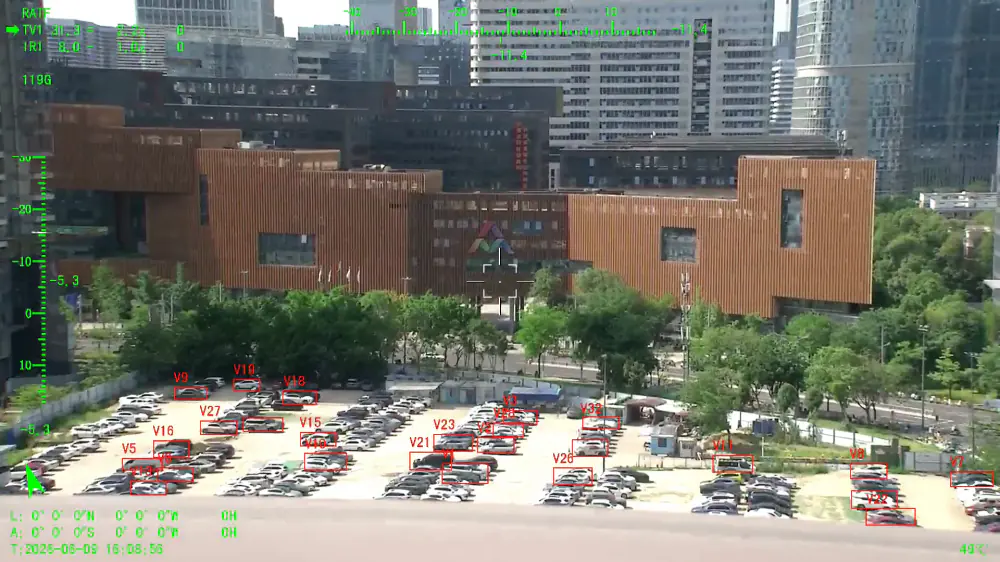
The visible channel is specified at 1920 × 1080, 30x zoom 4.3 – 129 mm. Detection distances for the visible channel are quoted at 6 km person / 15 km vehicle using the standard 1.7 m person and 2.3 m vehicle targets; recognition and identification distances are shorter and appear in the datasheet.
Thermal / IR
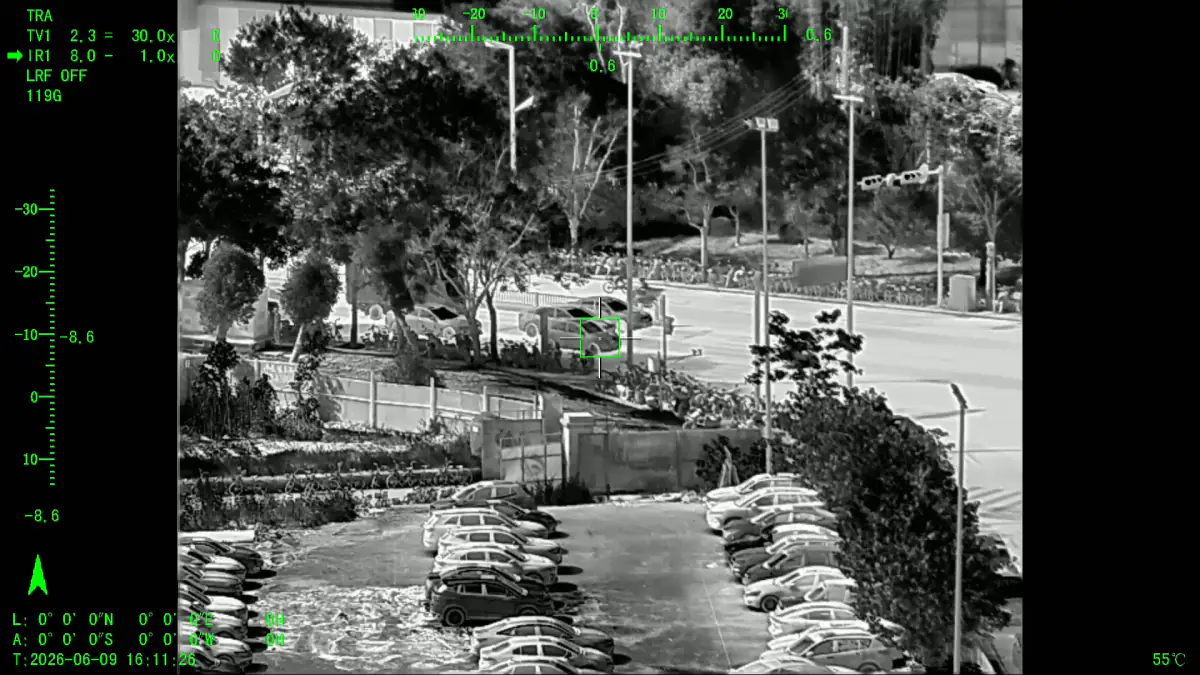
The thermal channel is 640 × 512, 35 mm fixed, uncooled long-wave infrared with NETD ≤ 40 mK. Thermal detection is quoted at 1 km person / 4.6 km vehicle. Performance does not depend on daylight, which is what makes the channel useful for night operations and for scenes obscured by smoke or dust.
Laser rangefinder
The laser rangefinder measures 120 m – 5 km (± 1 m) at an eye-safe 1535 nm. Range readings feed the target coordinate calculation, so the ground station receives a georeferenced position instead of a range bar in the video.
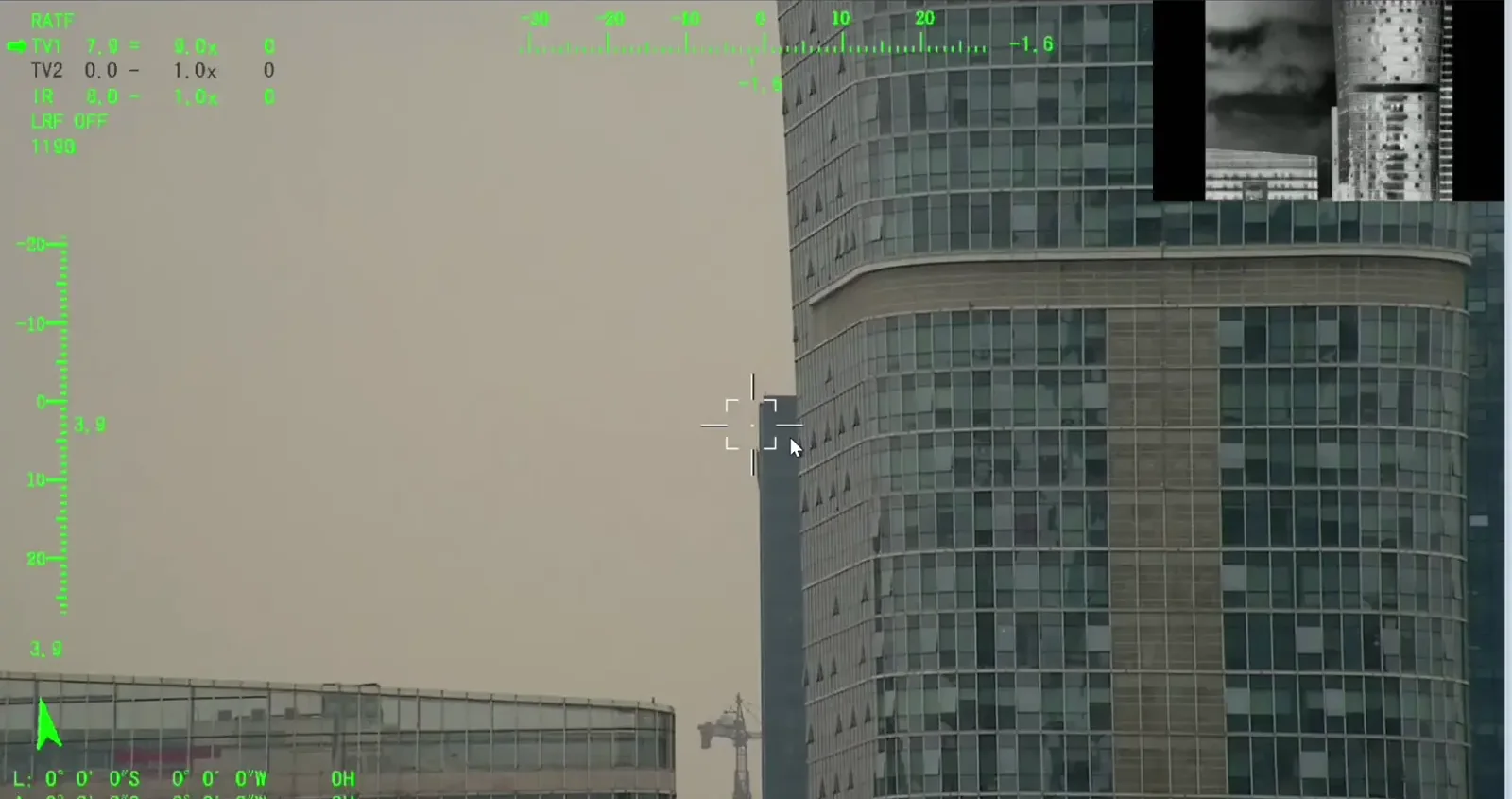
Detection and tracking at the edge
Onboard AI module
Detection, classification and tracking run on the payload, so the video feed stays usable when the data link degrades. The tracker locks onto a target selected on the ground station screen and holds it through occlusion, rotation and scale change.
What that means in the air
The operator sees a boxed target and a lock that survives occlusion rather than a raw feed. Because the module is common across the family, tracking behaviour does not change when the payload changes.
Tracking demonstration
Targets are boxed automatically as they appear, and the lock is held on the selected target even when it passes behind an obstruction.
Integration
One control protocol across the family
Every head in the range speaks the same control set, so moving from a two-axis to a three-axis payload, or adding a laser rangefinder, does not change the aircraft-side integration. The protocol document and video pipeline notes are supplied with the first unit.
Video, control and power
Video is carried as Ethernet in H.264 or H.265. The gimbal is controlled over RS-422, RS-232 or TTL with SBUS and MAVLink supported on the aircraft side, and power input is 11–28 VDC. Recording is handled on board, so the file exists even if the link drops.
Interface protocol document, video pipeline description and outline drawing are supplied with the first unit — ask the engineering team if you need them earlier for evaluation.
Full specifications
| Model | SQ-155T |
| Series | Laser Designator Pods (SQ series) |
| Stabilisation | Two-axis gyro-stabilised, ≤ 100 μrad |
| Sensor configuration | EO + IR + LRF + laser designator |
| Visible channel | 1920 × 1080, 30x zoom 4.3 – 129 mm |
| Thermal channel | 640 × 512, 35 mm fixed |
| Laser rangefinder | 120 m – 5 km (± 1 m) |
| Weight | ≤2.5 kg |
| Dimensions | ≤Φ155 × 213 mm |
| Power consumption | 30 W / 150 W |
| Detection (EO) | 6 km person / 15 km vehicle |
| Detection (IR) | 1 km person / 4.6 km vehicle |
Detection distances follow the standard 1.7 m person / 2.3 m vehicle convention. Rows marked as shared are common across the SQ series.
Shared across the SQ series
- Video output: Ethernet, H.264 / H.265
- Gimbal control: RS-422 / RS-232 / TTL, SBUS, MAVLink
- Input voltage: 11–28 VDC
- Operating temperature: −20 °C to +60 °C
- Sealing: Sealed housing for dust, wind and rotor wash
- Recording: On-board recording, imagery retained if the link drops
- AI module: Onboard detection, classification and multi-target tracking
- Mounting: Quick-release interface, adapters available for OEM airframes
Three-view outline drawing with connector pinout, available on request.
Mounting, interfaces and environment
Airframe integration is the part of a payload programme that is easiest to get wrong, so these are the numbers engineers ask for first. Everything below applies to the SQ-155T.
Mechanical interface
The head mounts on a quick-release interface with a vibration-isolated gimbal base, and adapter plates are available for OEM airframes that do not share our bolt pattern. Mass and envelope are the catalogue limits for this head, so the aircraft-side budget can be checked before a prototype is built.
Electrical and data interface
Power, control and video are separated so the head can be flown from most autopilots: 11–28 VDC input, serial control on RS-422 / RS-232 / TTL, and video over Ethernet. On-board recording keeps the imagery even if the downlink drops.
| Payload mass | ≤2.5 kg |
| Envelope | ≤Φ155 × 213 mm |
| Power consumption | 30 W / 150 W |
| Input voltage | 11–28 VDC |
| Data interfaces | Serial (RS-422 / RS-232 / TTL), Ethernet, SBUS |
| Video output | Ethernet, 100 Mbps, H.264 / H.265 |
| On-board storage | Up to 128 GB |
| Operating temperature | −20 °C to +60 °C |
| Storage temperature | −40 °C to +70 °C |
| Mounting | Quick-release interface, adapter plates for OEM airframes |
| Sealing | Sealed housing for dust, wind and rotor wash |
Input voltage, data interfaces, video output, temperature limits and on-board storage are common across the range. The released three-view drawing with the connector pinout is supplied with the datasheet — ask the engineering team if you need it for an airframe review before quotation.
Where the SQ-155T is used
Three mission profiles that match this weight class and sensor set.
- Persistent surveillance
A stabilised multi-sensor head on a long-endurance aircraft keeps one target under observation through weather, day and night.
- Camera on helicopter
Vibration isolation matters more on a rotorcraft, and the stabilisation loop is specified for exactly this environment.
- Corridor and route survey
Thermal and visible imagery in one pass, georeferenced by the rangefinder, shortens the time between flight and report.
Other heads in the range
Every model shares the same control protocol, video pipeline and AI module, so moving between them does not change the aircraft-side integration.
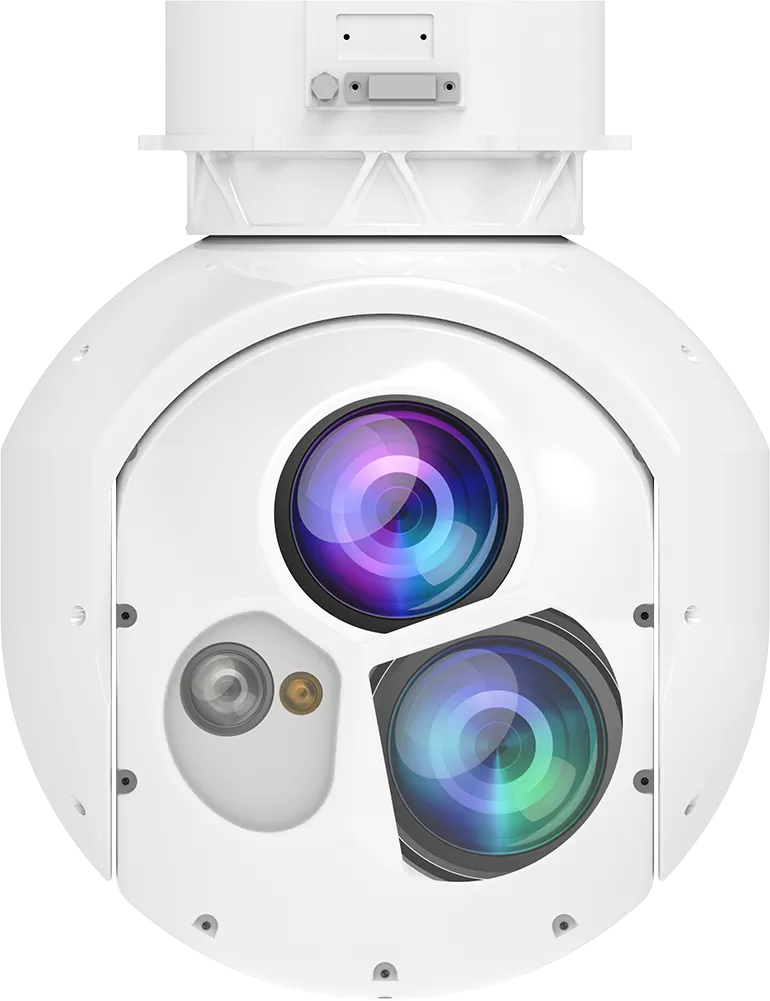
SQ series · 2-axis · EO + IR + LRF + laser designator
SQ-200T Laser Targeting Pod OEM
Laser designation plus 8 km ranging on a 5.5 kg two-axis pod.
- Weight
- ≤5.5 kg
- EO
- 1920 × 1080
- IR
- 640 × 512
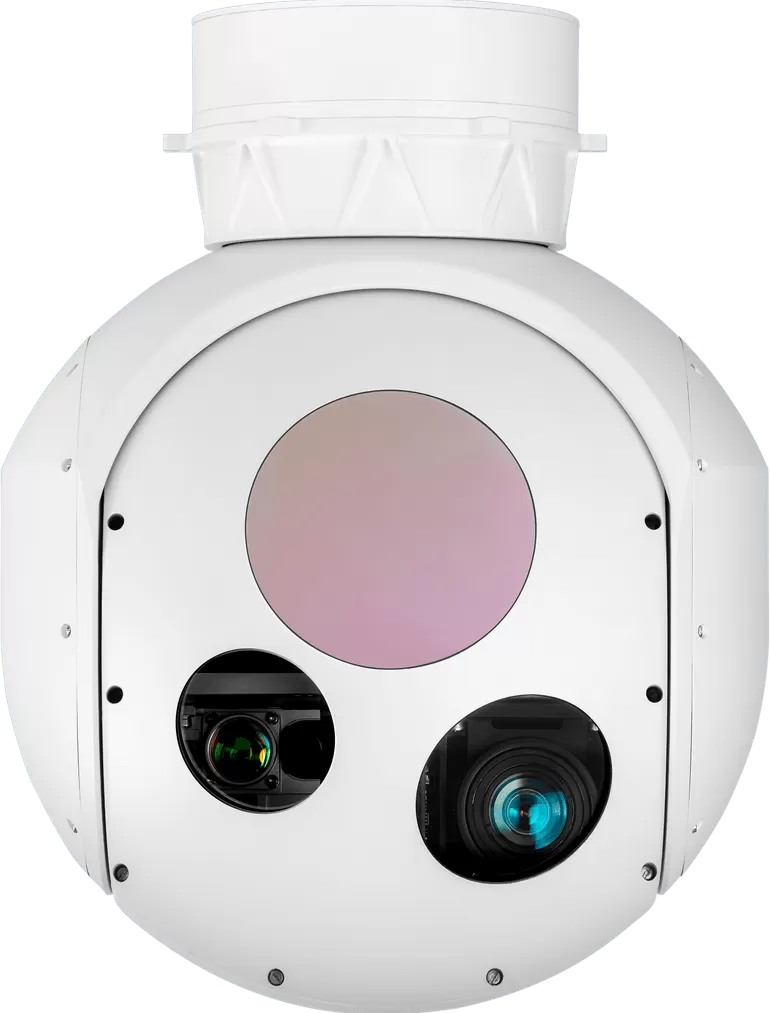
SQ series · 2-axis · EO + IR + LRF + laser designator
SQ-290T customized Laser Designator Pod
The long-range designator: 10 km ranging, a 300 mm thermal zoom and a 290 mm turret.
- Weight
- ≤15 kg
- EO
- 1920 × 1080
- IR
- 640 × 512
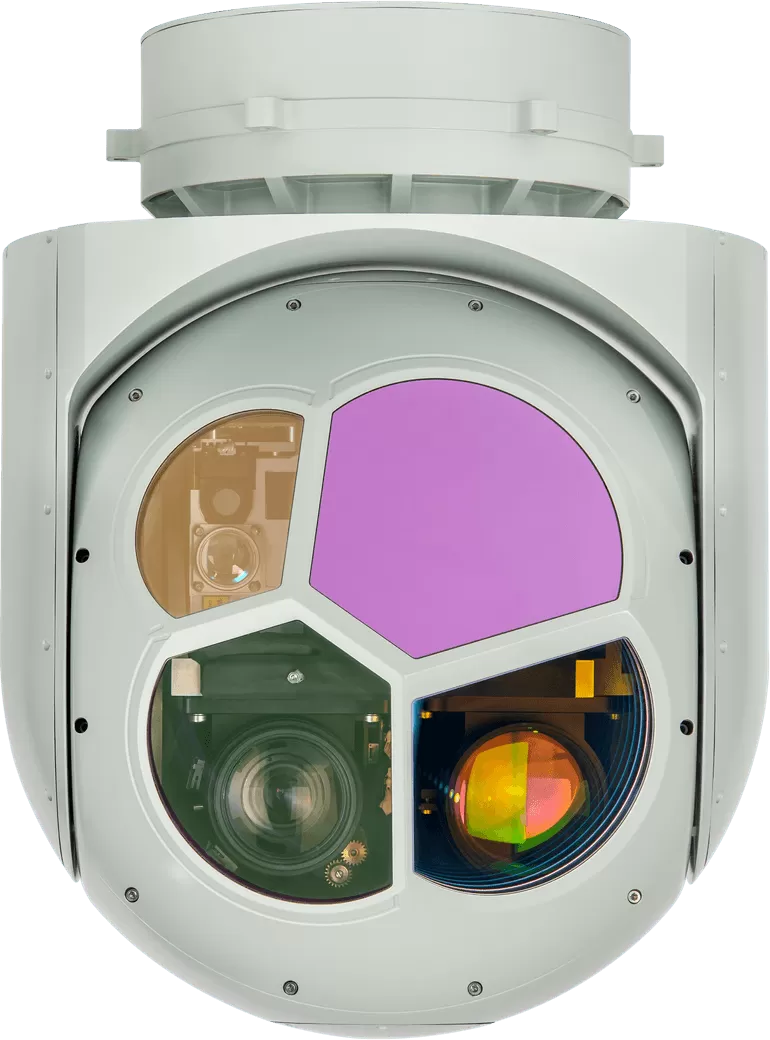
SQ series · 2-axis · EO + IR + LRF + laser designator
SQ-330Q Laser Designator Payload Supplier
The largest pod we build — a 330 mm turret and 22 kg of payload capacity for heavy platforms.
- Weight
- ≤22 kg
- EO
- 1920 × 1080
- IR
- Dual 640 × 512
Questions engineers ask about the SQ-155T
How far can the SQ-155T detect a person or a vehicle?
Detection is quoted at EO 6 km person / 15 km vehicle, IR 1 km person / 4.6 km vehicle against the standard 1.7 m person and 2.3 m vehicle targets.
Can the SQ-155T be adapted for an OEM programme?
Optics, servo hardware, stabilisation firmware and the AI module are developed in house, so the optical set, laser module, mounting interface and control protocol can be adapted. OEM and ODM projects normally start from an existing head.
Are a datasheet and a dimension drawing available?
Yes — the datasheet, outline drawing and interface document for the SQ-155T are supplied on request, together with the alignment and test data for the unit you receive.
Is a larger or a smaller head a better fit?
If the identification range in the requirement is longer than this configuration covers, the next step in the family is a heavier turret with a longer focal length and a larger aperture. If the aircraft is weight-limited, a lighter head normally keeps endurance.
What are the order terms for the SQ-155T?
One unit for a stock configuration, custom builds from 100 units. A head held in stock ships from inventory, so the lead time is transit rather than a production slot; payment is by T/T with the schedule on the quotation, and the warranty is one year from delivery with support from our own engineers online.
Designed and manufactured by HITS
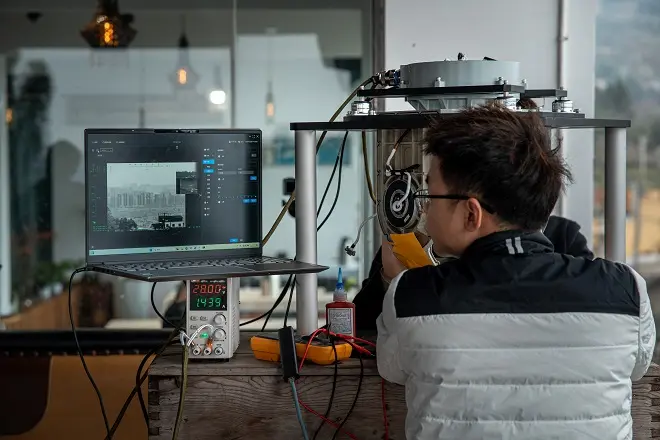
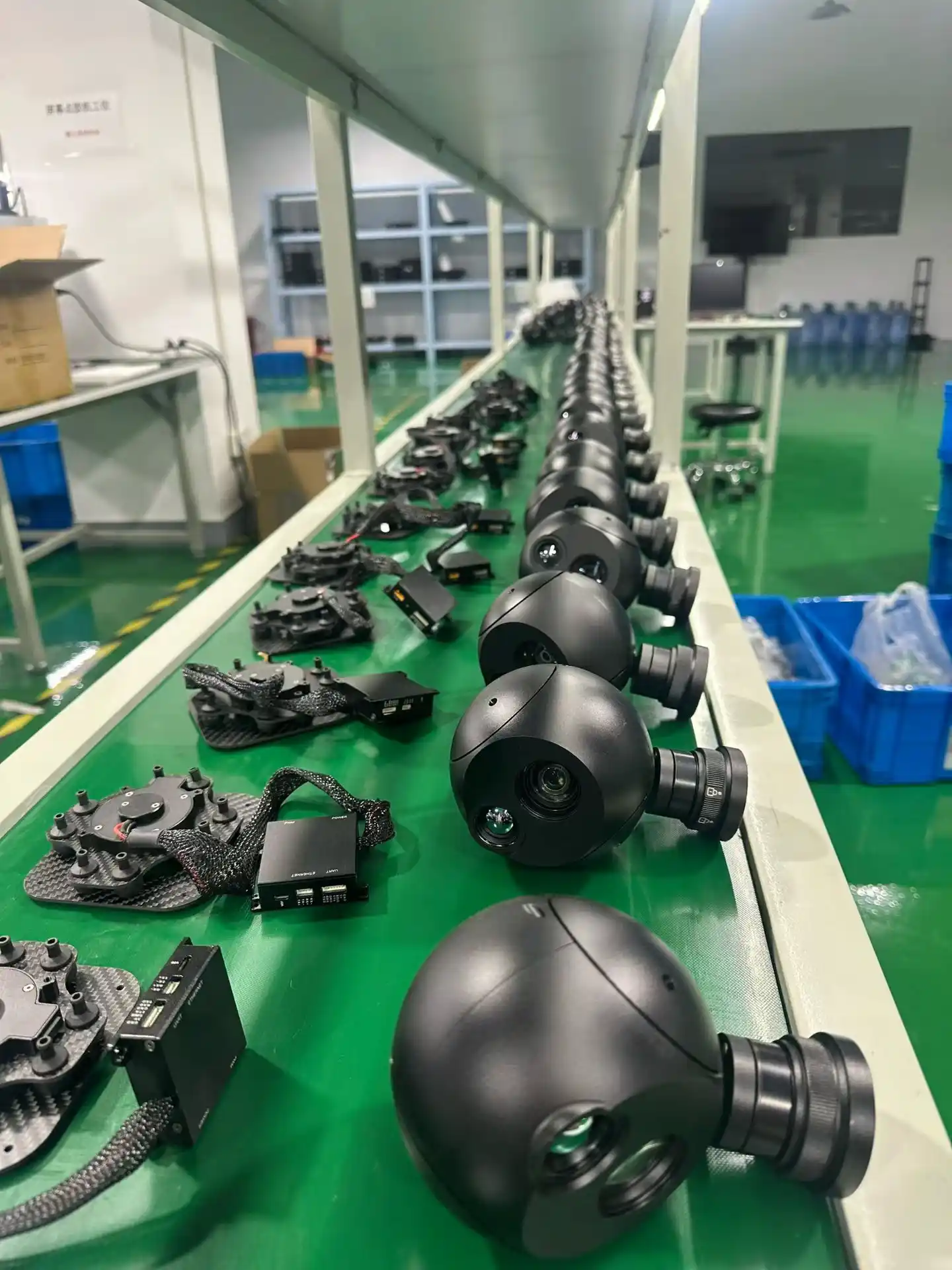
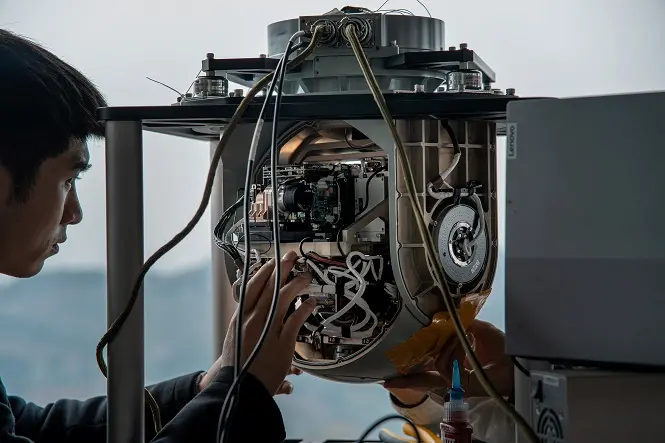
Optics, servo hardware, stabilisation firmware and the AI tracking module are developed in house, and every unit is assembled, calibrated and environmentally tested on our own line before it ships.

Request a quotation for the SQ-155T
Send the platform, the operating altitude and the identification range you need and we will confirm the configuration. Contact us with your requirements.