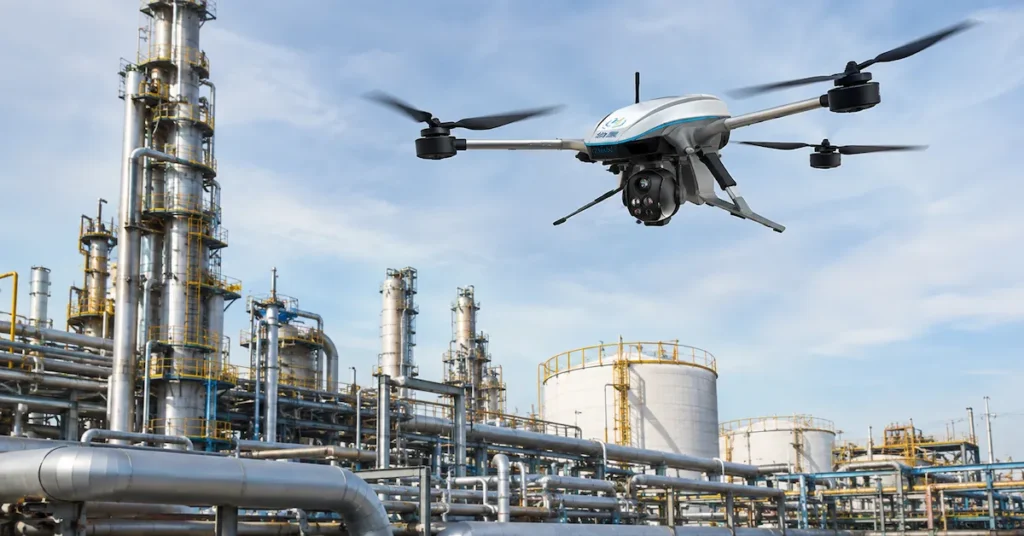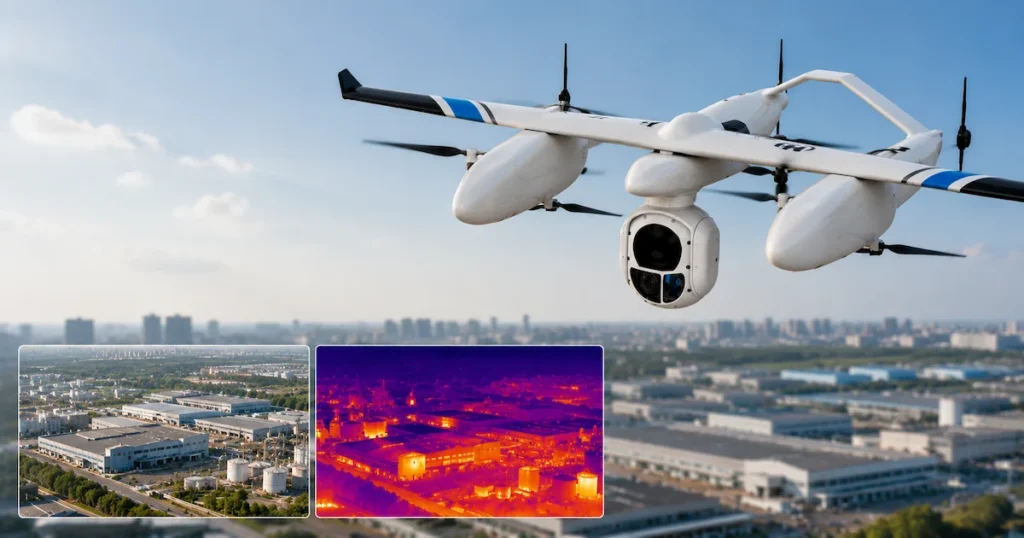
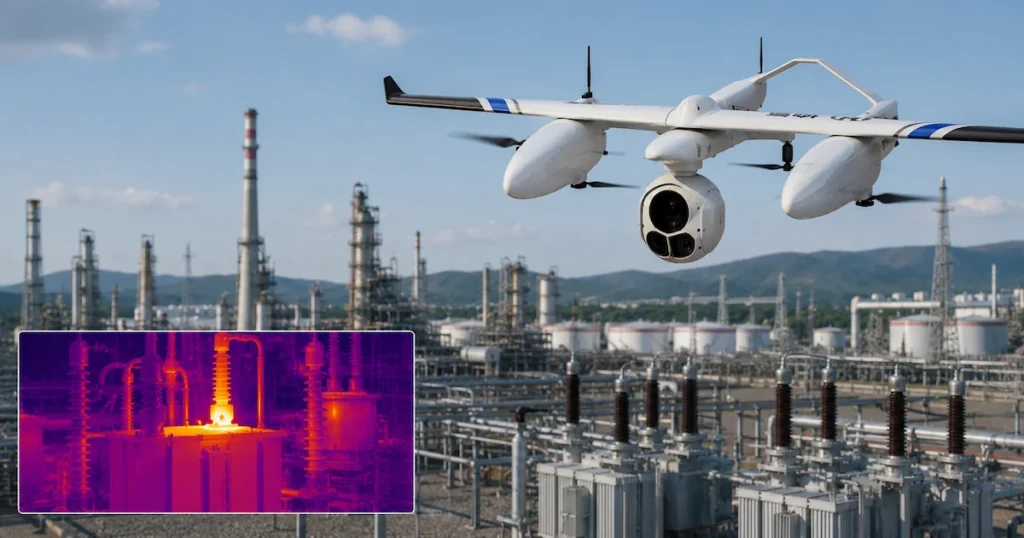
Thermal imaging has become an important sensing technology for professional UAV inspection. Unlike conventional cameras that capture visible surface details, a thermal imaging payload detects infrared radiation and converts temperature differences into thermal imagery. This allows drone operators to identify heat patterns and temperature anomalies that may not be visible to the human eye.
When integrated with a stabilized UAV platform, thermal imaging can support the inspection of electrical infrastructure, wind turbines, industrial facilities, oil and gas assets, and other difficult-to-access equipment. It can also provide valuable situational information during emergency response and low-light operations.
However, effective UAV thermal inspection involves more than simply mounting a thermal camera on a drone. Thermal resolution, sensitivity, lens selection, observation distance, stabilization, payload weight, and integration with EO cameras and AI processing can all influence mission performance.
This guide explains how thermal imaging payloads work, what they can detect, where they are used, and how to select the right configuration for professional UAV inspection.
What Is a Thermal Imaging Payload?
A thermal imaging payload is an airborne sensor system designed to detect infrared radiation emitted by objects and surfaces. Instead of creating an image primarily from visible light, the thermal sensor measures differences in infrared energy and converts them into a visual representation of temperature patterns.
For professional drones, the thermal sensor is typically integrated into a stabilized gimbal. Stabilization helps maintain a consistent line of sight while the UAV moves, allowing operators to collect more usable thermal imagery from the air.
Professional payload systems may combine the thermal camera with an electro-optical camera, optical zoom, laser rangefinder, onboard processing, AI recognition, and automatic tracking.
This multi-sensor approach is particularly useful for industrial inspection because a thermal anomaly often needs additional visual context. Thermal imaging can indicate where an unusual temperature pattern exists, while EO imaging can help operators understand what physical component or condition is associated with that anomaly.
How Thermal Imaging Works in UAV Inspection
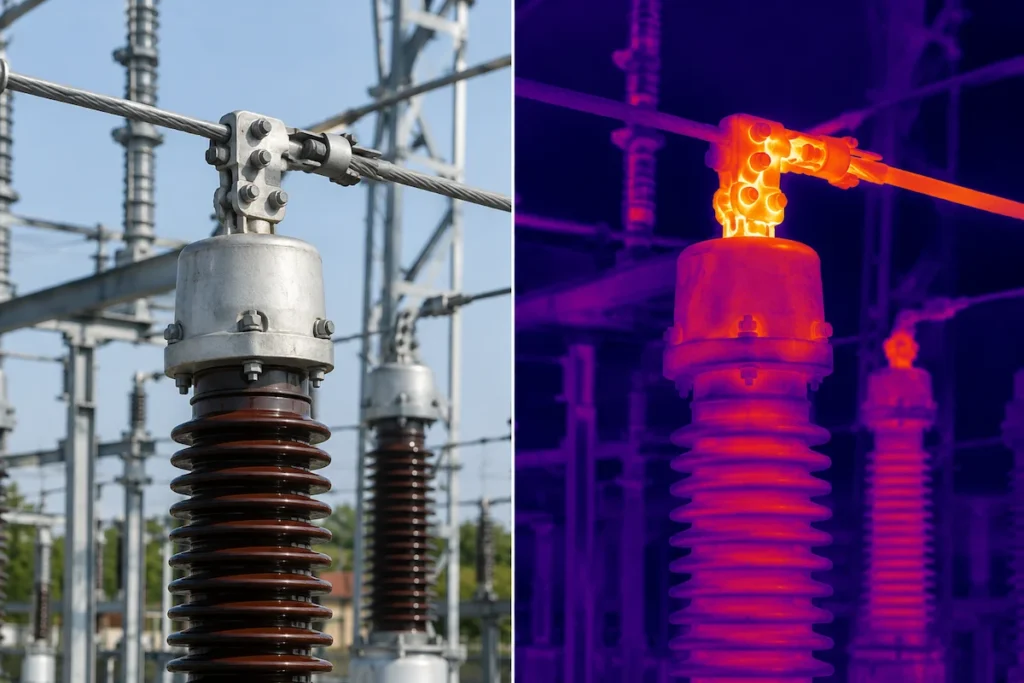
Every object above absolute zero emits infrared radiation. A thermal imaging sensor detects this energy and converts differences in infrared radiation into a thermal image.
During UAV inspection, the aircraft carries the thermal payload over or alongside the target infrastructure. The operator can observe thermal patterns in real time or record thermal data for later analysis.
Rather than simply looking for the hottest object in the image, professional inspection usually involves comparing temperature patterns across similar components, identifying localized hotspots, and evaluating abnormal thermal distribution.
For example, several electrical connectors operating under similar conditions may normally show comparable thermal patterns. If one connector appears significantly hotter than surrounding components, that difference may indicate a condition requiring further inspection.
Environmental factors also matter. Ambient temperature, sunlight, wind, viewing angle, distance, surface material, and equipment operating conditions can all influence thermal readings. For this reason, thermal imagery should be interpreted in the context of the actual inspection environment rather than treated as an isolated measurement.
What Can a Thermal Imaging Payload Detect?
The value of a thermal imaging payload comes from its ability to reveal temperature patterns that conventional visible-light imaging may not show.
Electrical Hotspots
Loose connections, abnormal resistance, overloaded components, and other electrical conditions can produce localized heating. Thermal imaging allows UAV operators to identify these hotspots without requiring direct physical access to energized equipment.
Overheating Components
Motors, bearings, transformers, generators, and other operating equipment can develop abnormal temperature patterns. Comparing components under similar operating conditions can help inspection teams identify areas that may require closer examination.
Abnormal Temperature Distribution
Not every issue appears as a single bright hotspot. Uneven or unexpected thermal distribution across equipment can also provide useful information about operating conditions.
Insulation and Heat-Loss Patterns
In selected industrial, building, and energy applications, thermal imaging can help reveal unusual heat transfer or insulation-related patterns that may not be obvious from visible imagery.
Fire and Residual Hotspots
During emergency operations, thermal sensors can help locate active heat sources and residual hotspots, including areas that may be difficult to identify using visible imagery alone.
Thermal imaging does not automatically determine the root cause of every anomaly. Instead, it provides another layer of inspection data that helps operators identify areas requiring further analysis.
Thermal Imaging for Power Grid and Electrical Inspection
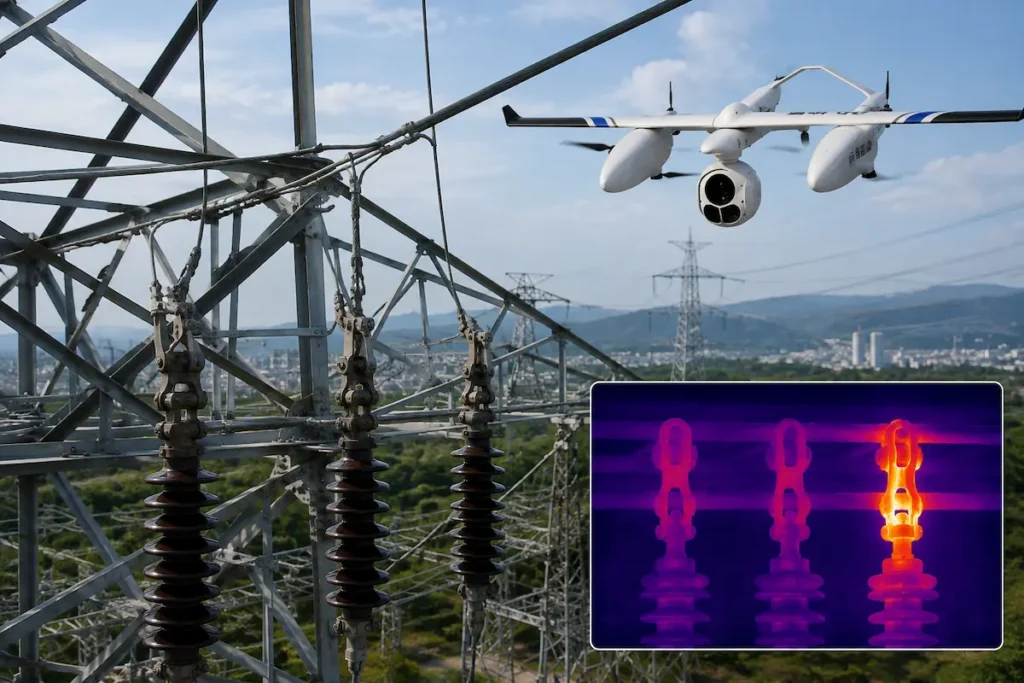
Power transmission and distribution infrastructure contains many components where abnormal heating can provide useful information about equipment condition.
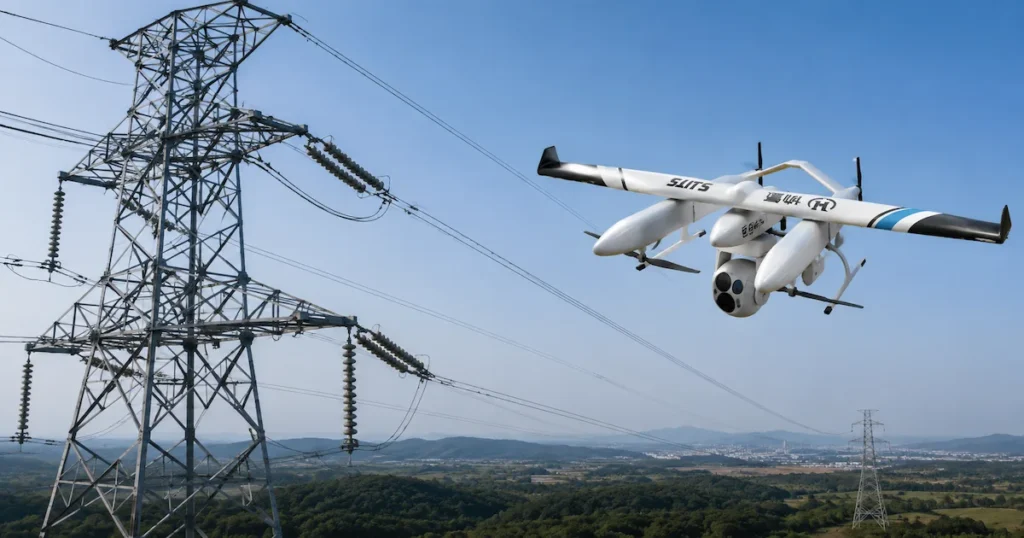
A UAV equipped with a thermal imaging payload can inspect transmission towers, substations, connectors, conductors, transformers, and other electrical assets from the air.
One of the most useful applications is identifying localized electrical hotspots. A connection with abnormal resistance, for example, may operate at a higher temperature than comparable connections nearby.
Thermal imaging allows operators to observe these differences while maintaining distance from energized infrastructure. When combined with a high-resolution EO camera, inspection teams can first locate the thermal anomaly and then examine the corresponding component visually.
This combination can improve inspection efficiency across large power networks and reduce the need for personnel to access difficult or hazardous locations during initial assessment.
For large-scale Power Grid Inspection programs, payload configuration should consider both thermal performance and the required observation distance.
Thermal Imaging for Wind Turbine Inspection
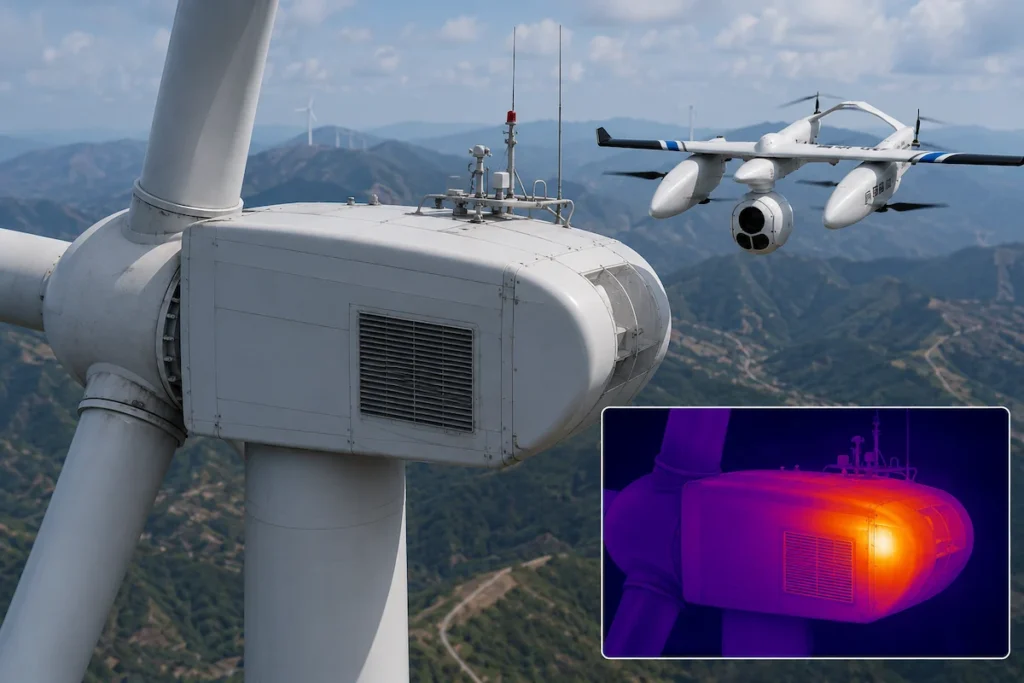
Wind turbines contain mechanical and electrical systems that can benefit from aerial thermal observation.
While visible-light cameras are commonly used to inspect blade surfaces and external structural conditions, thermal imaging can provide additional information about selected components and operating areas.
A UAV thermal inspection may observe the nacelle and associated equipment for unusual heat patterns, helping inspection teams identify areas that may require further investigation.
Depending on turbine design, operating conditions, sensor capability, and inspection procedure, thermal observation can support assessment of electrical equipment, generator areas, bearings, and other components where temperature differences may provide useful condition information.
Combining thermal and EO imagery is especially valuable. The thermal channel helps identify the location of an abnormal temperature pattern, while the optical channel provides visual context for the corresponding turbine structure.
For professional Wind Turbine Inspection, flight distance, viewing angle, thermal resolution, environmental conditions, and turbine operating state should all be considered when planning the mission.
Thermal Imaging for Oil & Gas and Industrial Inspection
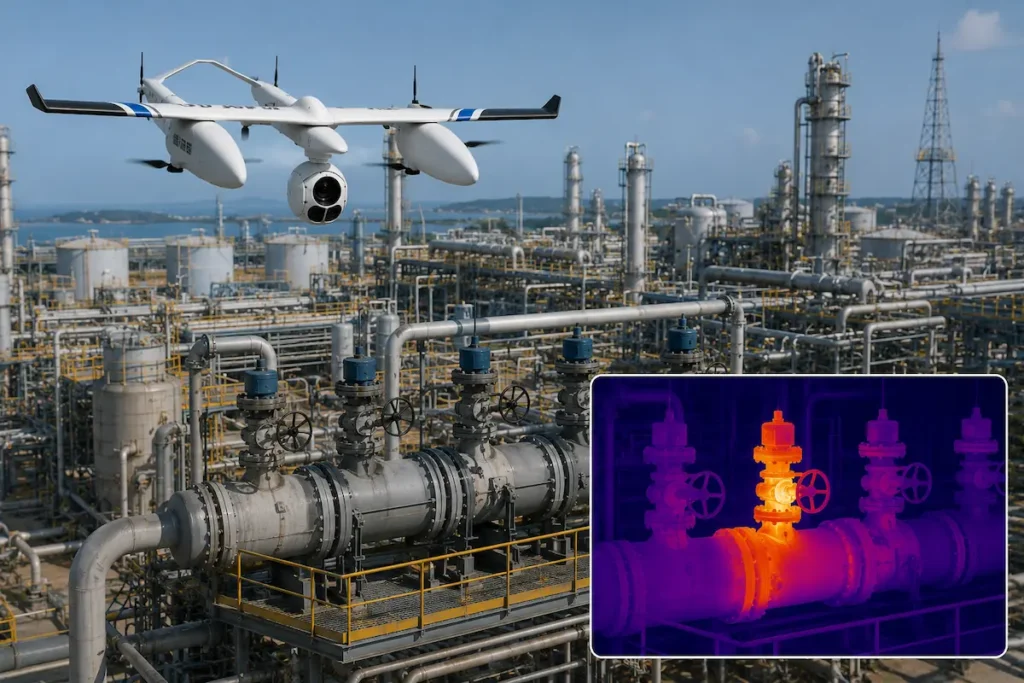
Oil and gas facilities, pipelines, processing plants, storage infrastructure, and other industrial assets often cover large areas and contain equipment that can be difficult to inspect manually.
Thermal imaging payloads allow UAVs to observe temperature patterns across selected equipment and infrastructure from the air.
Applications can include identifying unexpected temperature differences in operating equipment, examining heat distribution across industrial components, and supporting inspection of assets located in elevated or difficult-to-access areas.
Thermal imagery can also help inspection teams prioritize locations that require closer examination. Instead of manually approaching every component, operators can use aerial thermal observation to identify areas with unusual patterns and then conduct targeted follow-up inspection.
For Oil & Gas Surveillance and industrial monitoring, thermal imaging should be considered alongside the specific inspection objective. Different tasks may require different thermal sensors, lenses, observation distances, and supporting EO capabilities.
It is also important to distinguish thermal imaging from specialized gas-detection technologies. A conventional thermal camera should not automatically be assumed to detect every type of gas leak unless the payload includes sensing technology specifically designed for that purpose.
Thermal Imaging for Emergency Response and Public Safety
Thermal imaging can provide valuable aerial information when visible-light conditions are limited or when heat signatures are important to the mission.
During nighttime search operations, a thermal imaging payload can help operators identify heat signatures that may be difficult to see with a conventional camera.
During fire-related operations, thermal imagery can support observation of active heat sources and residual hotspots. This can provide additional situational information when smoke, darkness, terrain, or distance makes visual assessment more difficult.
Thermal cameras can also complement EO sensors during Emergency Response missions. The thermal channel helps locate temperature-based targets or anomalies, while the visible-light camera provides environmental and structural context.
For these missions, rapid deployment, stable imaging, suitable field of view, real-time video transmission, and reliable UAV integration can be just as important as thermal resolution.
Why Combine Thermal Imaging with EO and AI?
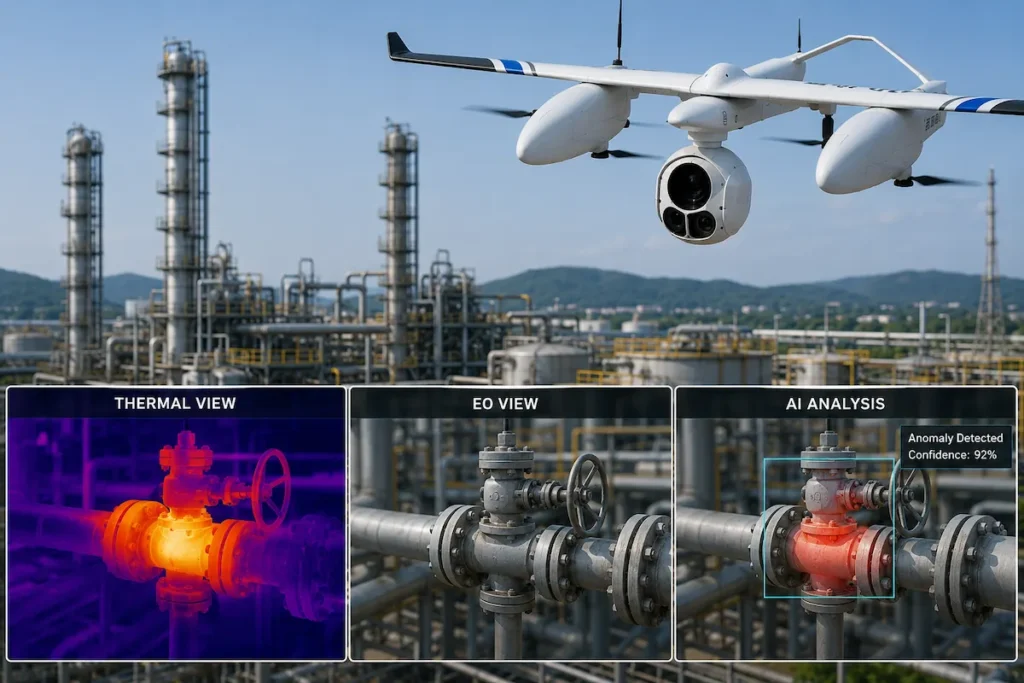
Thermal imaging is powerful, but professional UAV inspection often benefits from combining multiple sensing and processing technologies.
A thermal sensor can identify an unusual temperature pattern, but the thermal image alone may not always provide enough visual detail to determine the physical condition of the component.
An EO camera provides that additional context. Operators can compare thermal information with high-resolution visible imagery to better understand the location and appearance of an anomaly.
AI can add another layer of capability.
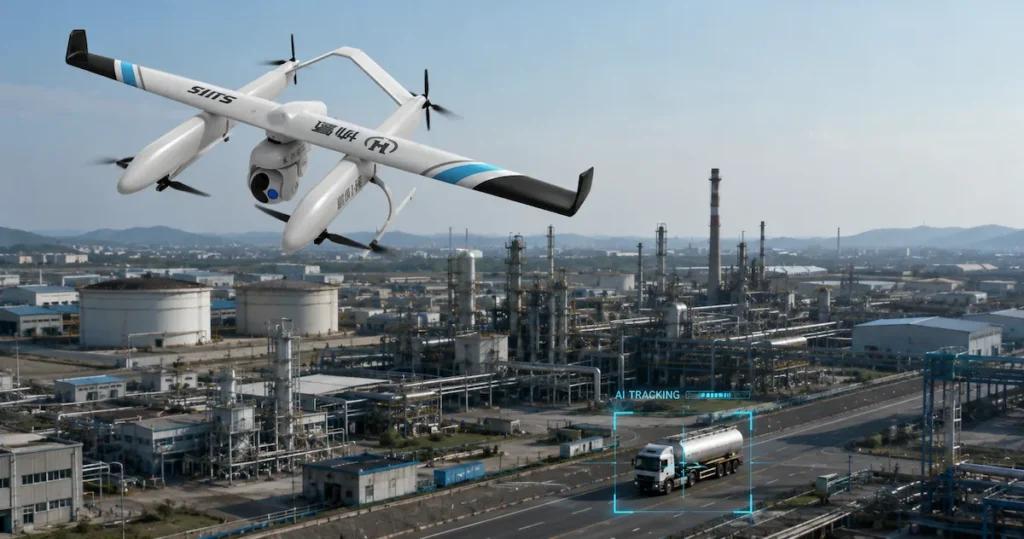
Depending on the application, AI recognition can help identify predefined infrastructure components or inspection targets. Automated analysis can assist in reviewing imagery for selected anomalies, while target tracking can help the stabilized payload maintain observation of an area of interest.
The workflow can therefore become:
Thermal imaging identifies an abnormal temperature pattern → EO imaging provides visual confirmation → AI assists recognition, tracking, or inspection analysis.
HITS UAV AI Payload Systems can combine EO imaging, IR thermal imaging, stabilization, laser ranging, and AI capabilities according to different professional UAV mission requirements.
The objective is not simply to add more sensors, but to configure the sensing system around the information the operator actually needs.
Learn more about how EO and IR sensors work together in professional UAV payloads.
Key Specifications for a UAV Thermal Imaging Payload
Choosing a thermal imaging payload requires evaluating several specifications in the context of the mission.
Thermal Resolution
Thermal resolution determines the number of detector pixels available to represent the scene. The required resolution depends on target size, observation distance, and the level of thermal detail needed.
Thermal Sensitivity
Thermal sensitivity affects the sensor’s ability to distinguish relatively small temperature differences. This can be important when the inspection objective involves subtle thermal anomalies rather than large temperature contrasts.
Lens and Field of View
Lens selection affects both field of view and the amount of detail available at a given distance. Wide-area monitoring and long-range component inspection may require different optical configurations.
Observation Distance
Payload performance should be evaluated at the actual working distance. A thermal camera that provides sufficient detail at close range may not meet the requirements of a long-range inspection mission.
Gimbal Stabilization
Stable imagery becomes increasingly important when observing small targets or operating at longer distances. Two-axis or three-axis stabilization can help maintain the sensor’s line of sight as the UAV moves.
Payload Weight and UAV Compatibility
The thermal payload must match the aircraft’s payload capacity, mounting interface, power supply, communication system, and endurance requirements.
For integrated EO/IR systems, the performance of the complete payload should be evaluated rather than focusing on the thermal sensor alone.
How to Choose a Thermal Imaging Payload for UAV Inspection
The most suitable thermal imaging payload should be selected according to the mission rather than a single headline specification.
Start by defining what needs to be detected. Electrical hotspots, mechanical overheating, wide-area thermal patterns, and emergency heat signatures may require different sensor configurations.
Next, determine the required operating distance and target size. These factors influence thermal resolution, lens selection, stabilization, and the amount of detail the operator can realistically obtain.
Consider whether the mission requires thermal imaging alone or a multi-sensor EO/IR system. Industrial inspection often benefits from having both thermal and visible imagery available from the same stabilized payload.
If automated workflows are important, determine whether AI recognition, tracking, or inspection algorithms are required.
Finally, confirm UAV compatibility, including payload weight, dimensions, mounting, power, video transmission, communication interfaces, and control protocols.
A well-matched thermal imaging payload should provide the sensing capability required by the mission without unnecessarily increasing payload complexity or aircraft load.
Frequently Asked Questions About Thermal Imaging Payloads
What is a thermal imaging payload for a drone?
A thermal imaging payload is an infrared sensing system mounted on a UAV, typically using a stabilized gimbal. It detects infrared radiation and converts temperature differences into thermal imagery for inspection, observation, and other professional applications.
What can drones detect with thermal imaging?
Depending on the application and sensor configuration, UAV thermal imaging can help identify electrical hotspots, overheating equipment, abnormal temperature distribution, selected heat-loss patterns, active heat sources, and residual hotspots.
Can thermal imaging detect problems that normal cameras cannot see?
Yes. Thermal imaging can reveal temperature differences that may not produce obvious visible changes. However, EO imagery is often valuable for providing visual context and helping operators interpret the location of a thermal anomaly.
How do I choose a thermal camera payload for UAV inspection?
Consider the target, operating distance, thermal resolution, sensitivity, lens and field of view, stabilization, payload weight, UAV compatibility, and whether EO imaging or AI capabilities are also required. The payload should be configured according to the actual inspection mission rather than selected on one specification alone.