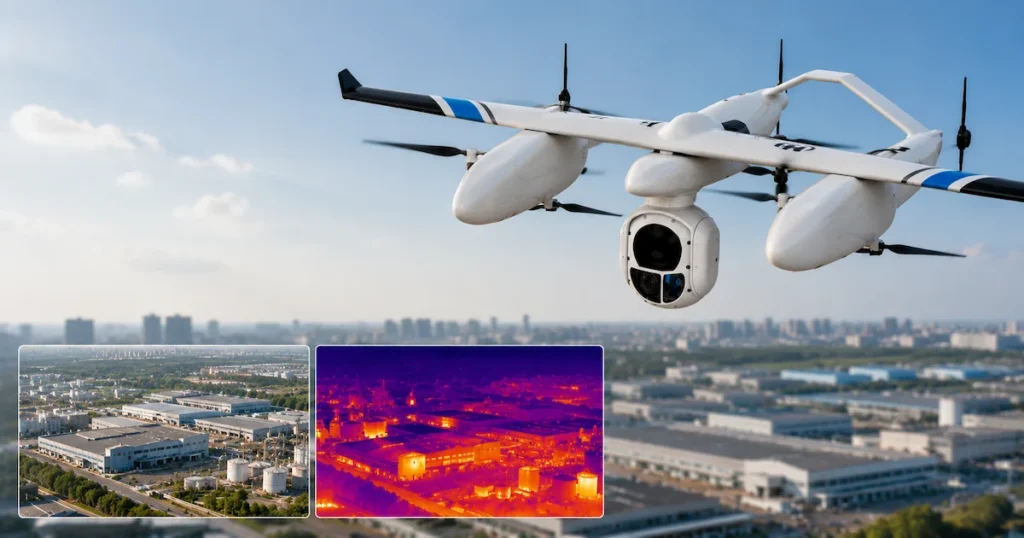
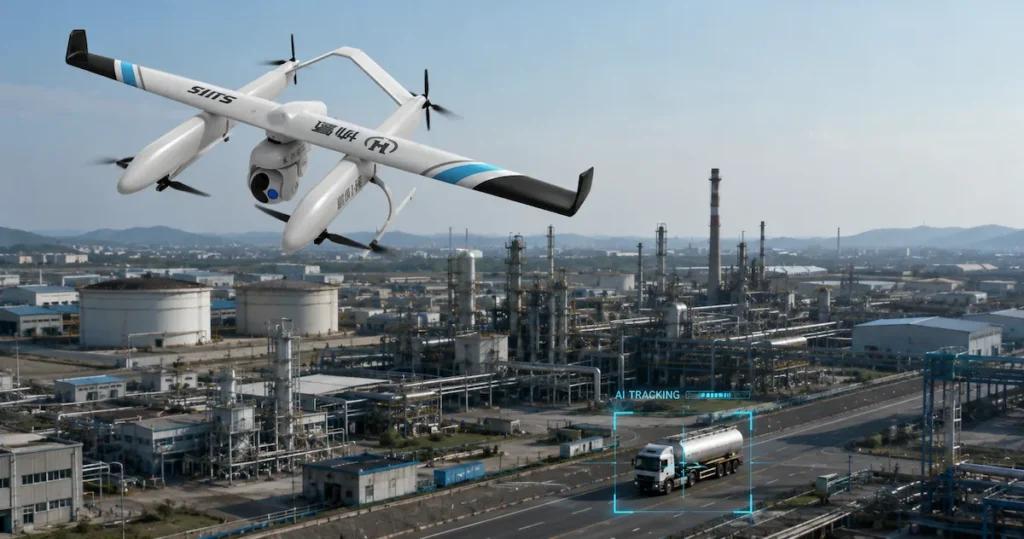
AI tracking technology is changing how professional drones perform surveillance, monitoring, and situational awareness missions. Instead of relying entirely on operators to manually locate and follow objects in live video, AI-enabled payloads can assist with target detection, recognition, and continuous tracking.
For professional UAV systems, however, AI tracking is more than a software feature that places a box around an object. Effective tracking depends on the complete sensing system, including EO and IR cameras, onboard processing, tracking algorithms, gimbal stabilization, communication links, and UAV integration.
When these technologies work together, a drone can detect an object within the sensor image, identify or classify it according to the available algorithm, and maintain continuous observation as the UAV or target moves.
This guide explains how AI tracking technology works on professional drones, how detection and recognition differ from tracking, why EO/IR sensors and stabilized payloads matter, and what to consider when selecting an AI tracking payload for UAV surveillance.
What Is AI Tracking Technology for Drones?
AI tracking technology uses computer vision and machine-learning algorithms to help a UAV sensing system detect and continuously observe selected objects within video imagery.
A typical system begins with an EO or IR camera capturing the scene. AI algorithms analyze the incoming image data and identify potential targets according to predefined object classes or mission-specific models.
Once a target has been selected, the tracking algorithm estimates its position from frame to frame. If the payload is mounted on a controllable gimbal, tracking information can also be used to adjust the sensor’s line of sight and keep the selected target within the observation area.
The result is a coordinated process involving:
Sensor imaging → AI detection → target selection or recognition → tracking → gimbal control → continuous observation.
The exact capabilities depend on the sensor configuration, AI model, onboard computing resources, tracking algorithm, operating environment, and UAV platform.
How AI Target Tracking Works on a UAV
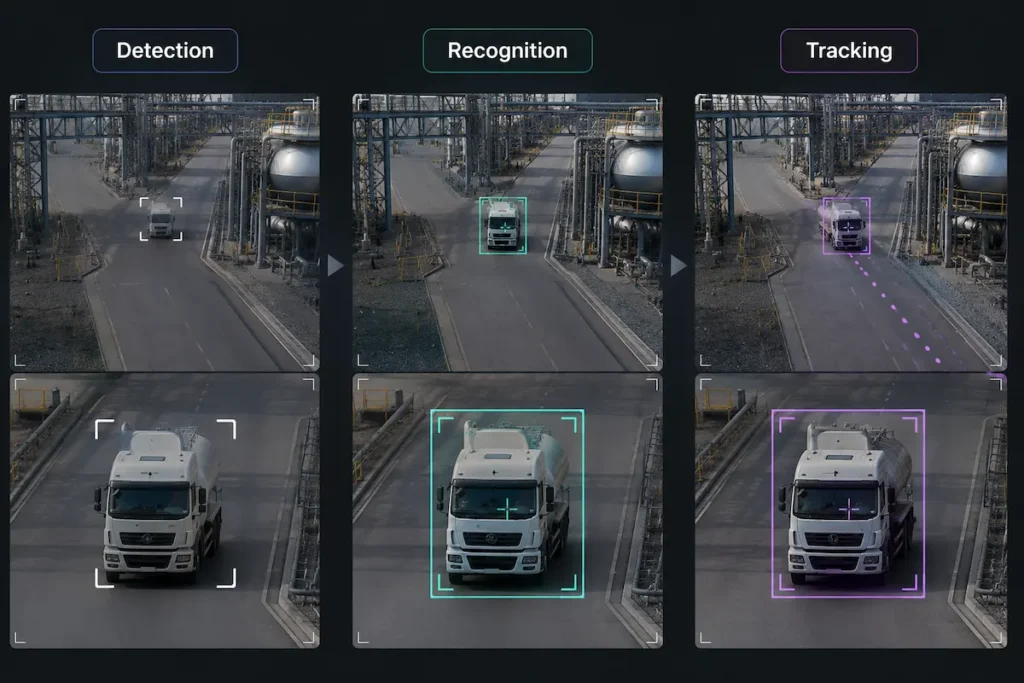
AI target tracking typically starts with image data from the drone’s payload. Depending on the mission, this may come from a visible-light EO camera, an infrared sensor, or a multi-sensor EO/IR payload.
The processing system analyzes consecutive video frames to locate objects of interest. After a target is detected or selected, the tracking algorithm estimates changes in its position as new frames arrive.
Tracking becomes more challenging when the UAV itself is moving. Aircraft motion, vibration, changing viewing angles, background changes, and variations in target size can all affect the image.
This is why professional tracking systems often combine AI processing with a stabilized gimbal. The algorithm determines where the target is located in the image, while the gimbal adjusts the sensor direction to maintain observation.
Rather than operating as separate technologies, the camera, AI processor, tracking algorithm, gimbal controller, and UAV communication system work together as an integrated sensing platform.
AI Detection vs Recognition vs Tracking
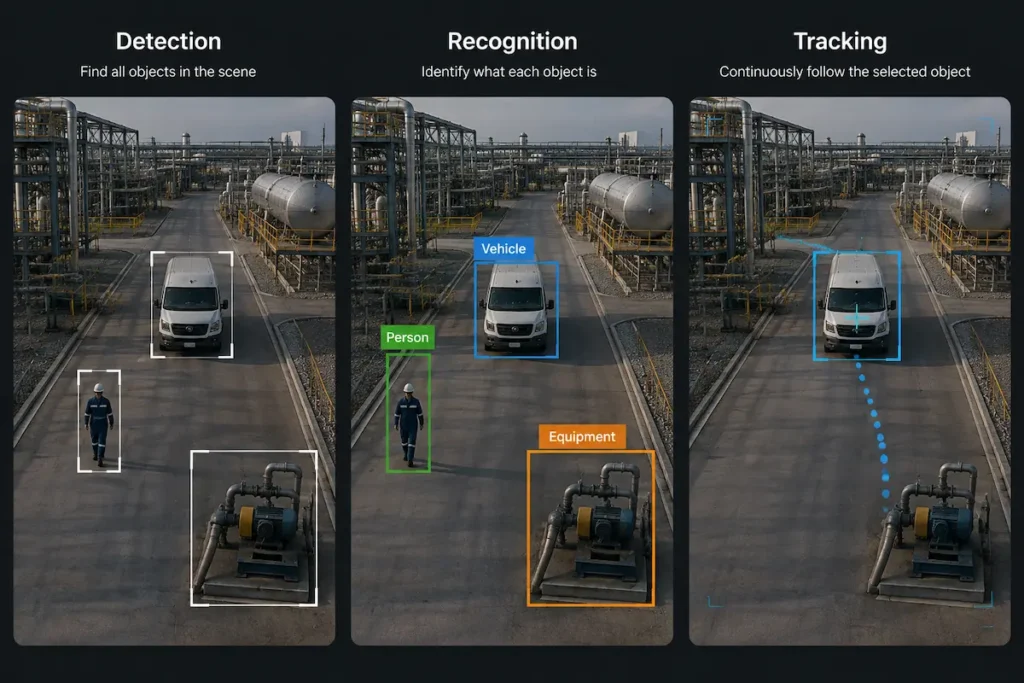
Detection, recognition, and tracking are related technologies, but they perform different tasks.
Target Detection
Detection answers the question:
Where is the object?
An AI detection algorithm searches the image for predefined objects and identifies their locations. Depending on the trained model, these could include vehicles, people, infrastructure components, or other mission-specific targets.
Target Recognition
Recognition helps answer:
What is the object?
After detecting an object, an AI model may classify it according to categories it has been trained to recognize. The available recognition capability therefore depends on the algorithm and training data.
Target Tracking
Tracking answers:
Where did the same target move?
Once an object has been selected, the tracking algorithm follows its position across successive video frames.
A simple way to understand the relationship is:
Detection finds it → Recognition identifies it → Tracking follows it.
Not every mission requires all three functions, so the appropriate AI capability should be selected according to the operational requirement.
Single-Target and Multi-Target Tracking
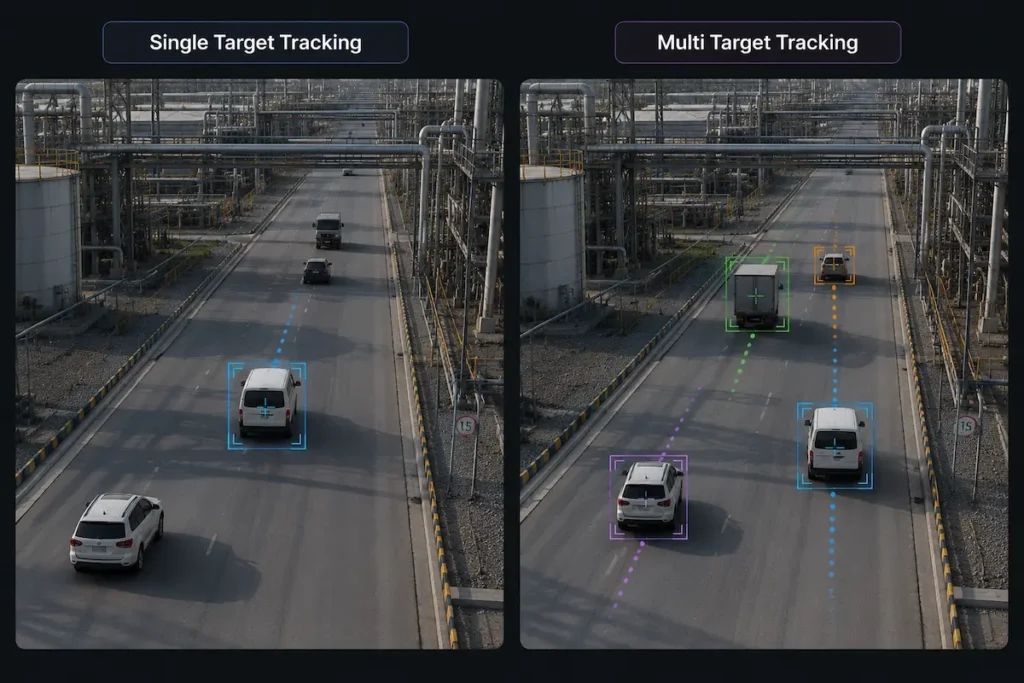
Professional UAV payloads can support different tracking modes depending on the software and computing platform.
Single-target tracking focuses on one selected object. Once the target is chosen, the system continuously estimates its position and can command the stabilized gimbal to maintain observation as either the UAV or target moves.
This is useful when operators need continuous visual information about a specific vehicle, person, asset, or other selected object.
Multi-target tracking allows the processing system to maintain information about several detected objects within the same scene. Each target can be assigned a separate track so that the system can distinguish between objects as they move.
The number of targets that can be processed and the reliability of tracking depend on factors such as image quality, target size, scene complexity, algorithm design, and onboard computing performance.
Why EO and IR Sensors Matter for AI Tracking
The effectiveness of AI tracking depends heavily on the quality of the sensor data provided to the algorithm.
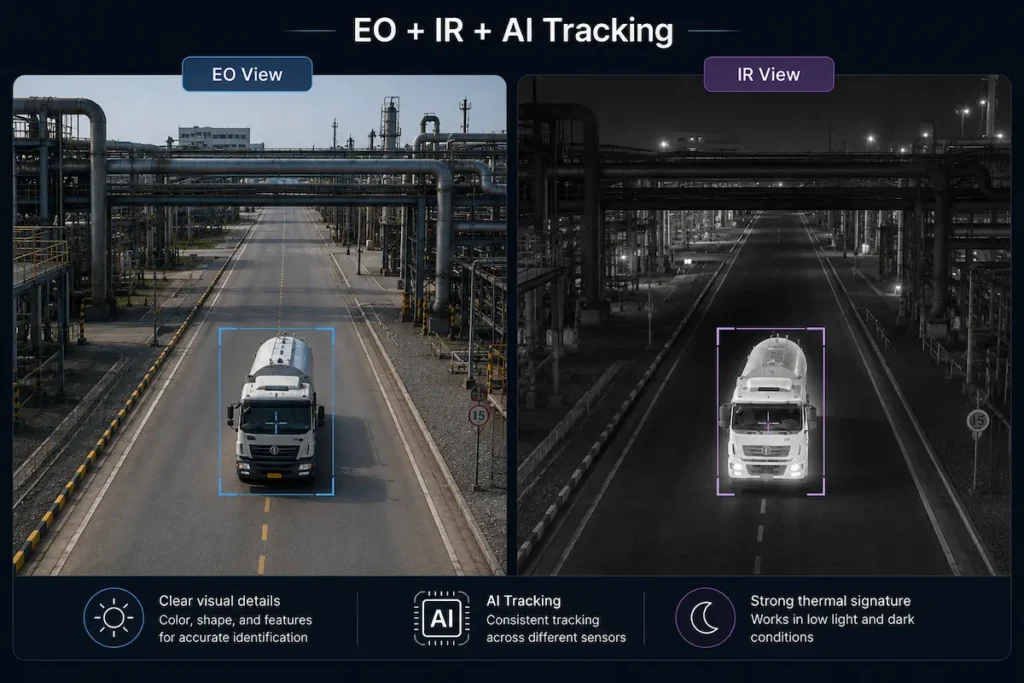
An EO camera captures high-resolution visible-light imagery and can provide detailed information about objects during suitable lighting conditions. Optical zoom can also support observation when the UAV must remain farther from the target.
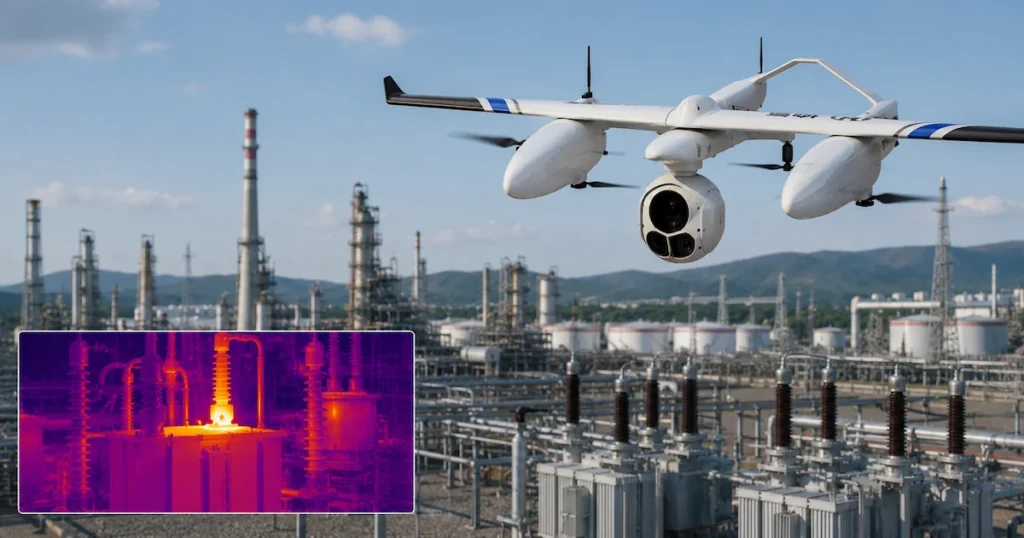
An IR thermal sensor provides a different type of information by detecting thermal radiation. This can support observation when visible-light conditions are limited or when thermal contrast helps distinguish a target from its surroundings.
Combining both sensors within an EO IR payload gives operators access to complementary visible and thermal information from the same stabilized platform.
AI can then assist with detection, recognition, and tracking based on the available sensor imagery. The most appropriate sensor channel depends on the target, environment, lighting, distance, and mission objective.
For applications where thermal information is particularly important, a dedicated thermal imaging payload can also support nighttime observation and temperature-based detection tasks.
Edge AI Processing for Drone Surveillance
AI processing can take place at a ground station, on a remote computing system, or directly onboard the UAV payload system.
With edge AI processing, selected image-analysis tasks are performed close to the sensor using an onboard processor. Instead of transmitting all video data to another system before analysis begins, the payload can process selected information locally.
This can help reduce processing latency and support faster detection or tracking responses. It can also reduce dependence on continuous high-bandwidth transmission for certain AI functions.
For professional drone surveillance, edge processing can be particularly useful when communication bandwidth is limited or when tracking decisions need to be made quickly.
However, onboard computing also introduces requirements for processing performance, power consumption, thermal management, payload weight, and software integration. These factors should be considered as part of the complete UAV system rather than evaluating the AI processor independently.
AI Tracking Applications in Drone Surveillance
AI tracking can support several professional UAV missions where continuous observation of moving or selected targets is important.
Long-range EO/IR payloads combined with AI tracking can assist operators in detecting and maintaining observation of selected moving targets across large monitoring areas.
Critical Infrastructure Monitoring
Around power facilities, industrial sites, pipelines, and other critical infrastructure, AI-assisted observation can help operators maintain awareness of selected vehicles, people, or predefined objects within the monitored environment.
During emergency operations, AI tracking can help maintain observation of selected people, vehicles, or other mission-relevant targets while the UAV and ground teams are moving.
Long-Range Situational Awareness
Combining optical zoom, EO/IR sensing, stabilization, and automatic tracking can support continuous observation when the aircraft must operate at greater distances from the target.
In each application, AI should support operator awareness rather than replace mission-specific procedures and human decision-making.
AI Tracking with Stabilized UAV Payloads
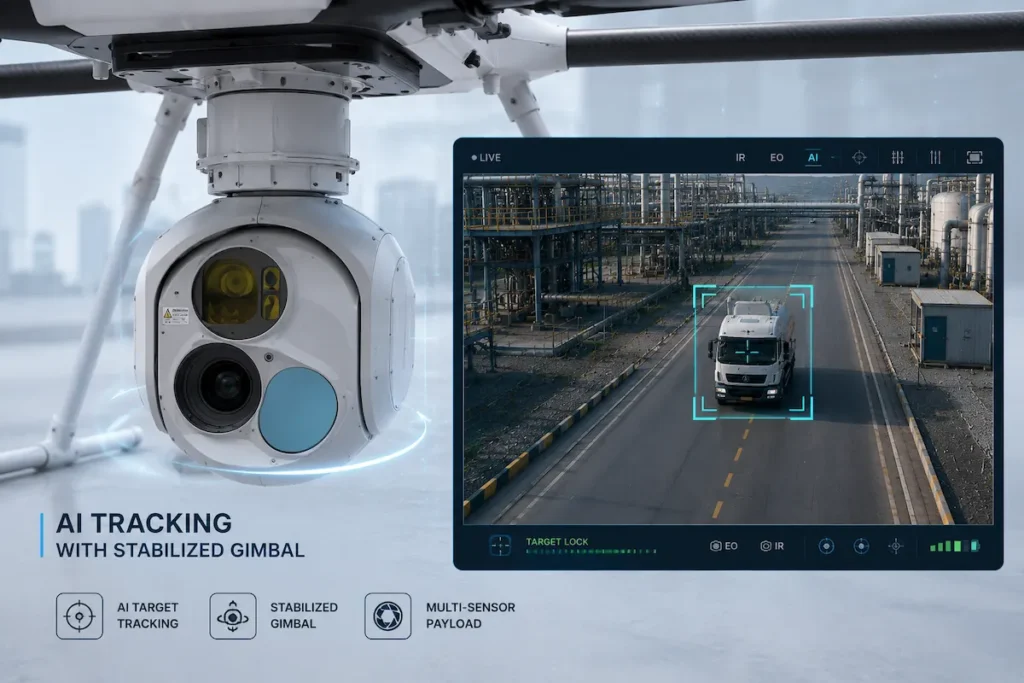
Tracking software alone cannot guarantee stable observation from a moving aircraft.
UAV vibration, wind, aircraft attitude changes, and long focal lengths can make it difficult to keep a target centered within the sensor image. These effects become increasingly important during long-range observation.
A stabilized gimbal helps isolate the camera’s line of sight from aircraft movement. When integrated with the tracking algorithm, the system can use target-position information to command the gimbal and continuously adjust the sensor direction.
The basic control process is:
AI estimates target position → tracking controller calculates movement → gimbal adjusts line of sight → sensor continues observing the target.
Two-axis and three-axis gimbal configurations may be used depending on the payload design and mission requirements.
Key Factors When Choosing an AI Tracking Payload
Selecting an AI tracking payload should begin with the mission rather than a list of software features.
1. Define the Tracking Target
Determine what the system needs to detect or track. Requirements for vehicles, people, infrastructure assets, or customized targets may require different AI models and sensor configurations.
2. Determine the Observation Distance
Target size and working distance affect camera resolution, optical zoom, thermal sensor selection, stabilization, and the amount of image detail available to the algorithm.
3. Select the Sensor Combination
Consider whether the mission requires EO only, EO + IR, or additional sensors such as a laser rangefinder. Multi-sensor payloads can provide more information but also increase system complexity.
4. Define the Required AI Functions
Determine whether the mission requires detection, recognition, single-target tracking, multi-target tracking, or customized inspection and monitoring algorithms.
5. Evaluate Onboard Computing
Processing performance, latency, power consumption, software compatibility, and thermal management should be evaluated when AI functions run onboard the payload.
6. Confirm UAV Compatibility
Payload weight, dimensions, mounting interface, power supply, communication protocols, video transmission, and gimbal control must be compatible with the UAV platform.
Integrating AI Tracking into Professional UAV Systems
AI tracking performs best when it is designed as part of the complete UAV sensing system rather than added as an isolated software feature.
Sensor selection affects the quality of the imagery available to the algorithm. Computing hardware determines how quickly image data can be processed. Stabilization influences whether the target remains observable, while communication interfaces determine how commands, video, metadata, and tracking information move between the payload, aircraft, and ground station.
For UAV manufacturers and system integrators, these requirements should be considered early in the integration process.
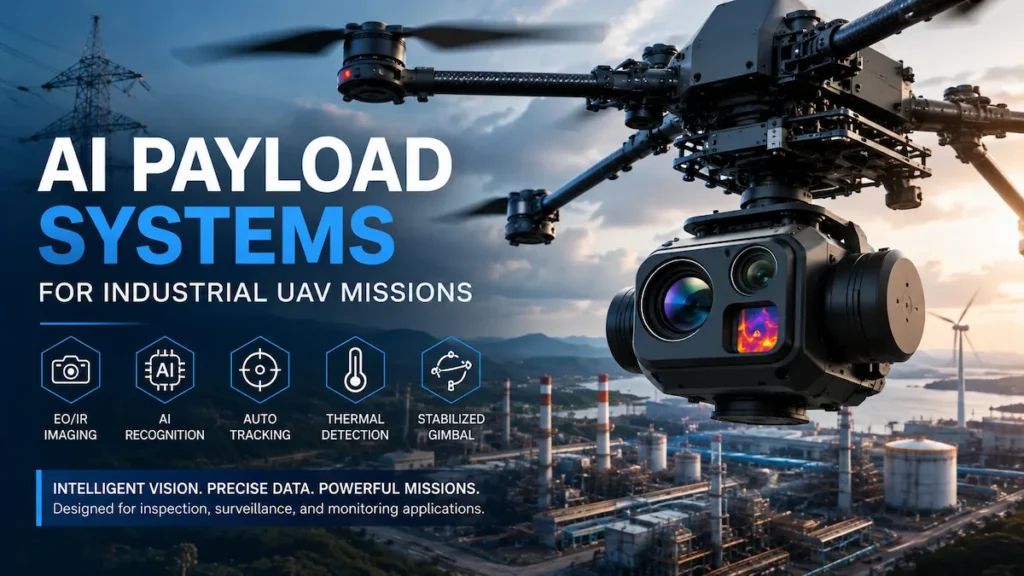
HITS UAV provides configurable AI Payload Systems that can integrate EO imaging, IR thermal imaging, AI recognition, automatic tracking, stabilization, and optional laser ranging according to professional UAV mission requirements.
The appropriate configuration should ultimately be determined by the target, observation distance, operating environment, UAV platform, and information required by the operator.
Frequently Asked Questions About AI Drone Tracking
What is AI tracking technology for drones?
AI tracking technology uses computer vision algorithms to detect or select an object in UAV imagery and continuously estimate its position across video frames. When integrated with a stabilized gimbal, the system can also adjust the sensor direction to maintain observation.
What is the difference between AI detection and target tracking?
Detection identifies the location of an object within an image, while tracking follows the same selected object across consecutive video frames. Recognition may additionally classify what type of object has been detected.
Can AI drone tracking work at night?
Yes, depending on the sensor configuration. AI tracking can use imagery from an infrared thermal sensor when visible-light conditions are limited, although performance depends on target contrast, sensor quality, algorithm capability, and environmental conditions.
Can an AI payload track multiple targets?
Some AI payload systems can support multi-target tracking. The number of targets and tracking performance depend on the algorithm, sensor imagery, computing platform, target characteristics, and complexity of the scene.